 电子邮件: info@guanyumixer.com
If a 30,000 mPa·s sauce keeps reaching the filler with pinholes, the vacuum pump gets the blame first. In our experience the pump is rarely the cause.
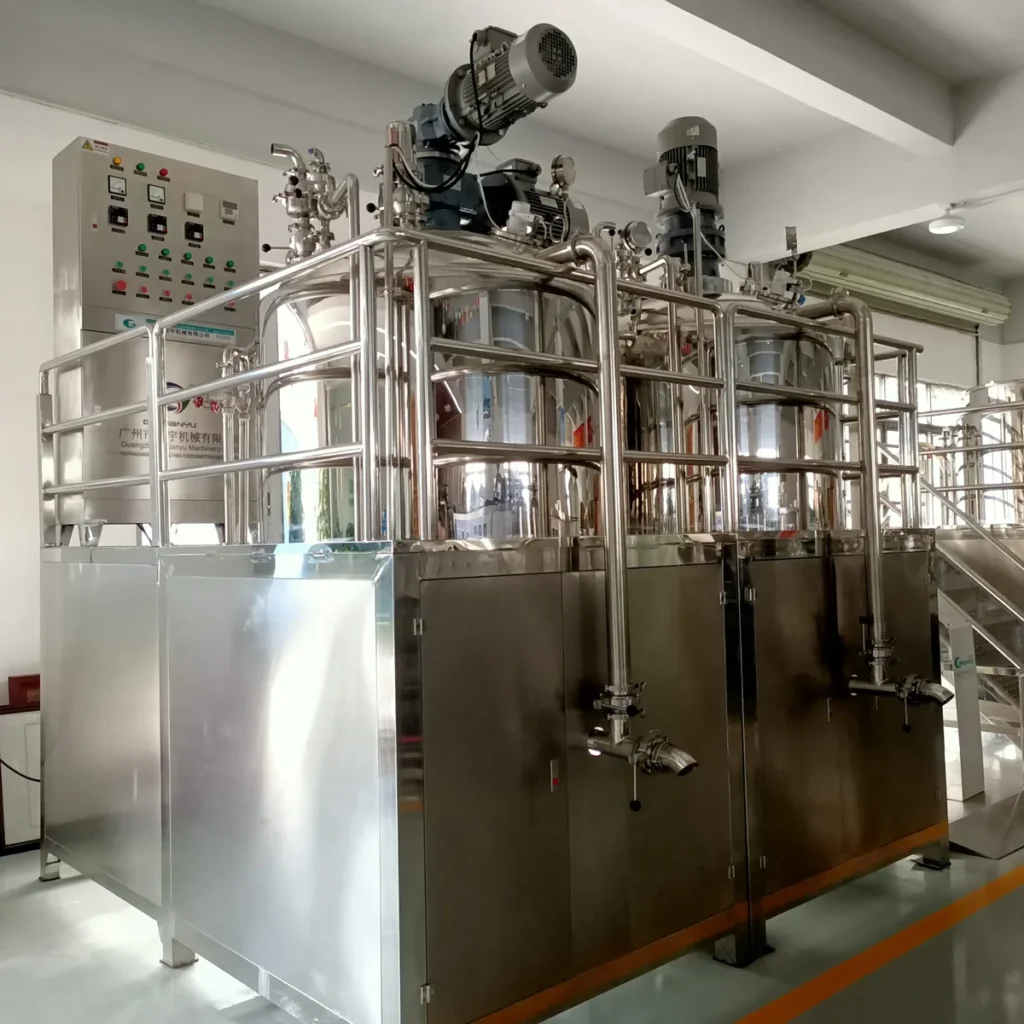
The tank simply never exposes new product surface to the vacuum, so the air pulled in during powder addition has no route out. 一个 high viscosity vacuum emulsifier is not a standard unit with a larger motor: it is a different arrangement of agitator, homogenizer and vacuum port.
This guide covers the six decisions that separate a vacuum emulsifying line for high viscosity foods that holds a 90-minute batch from one that runs six hours. Each point is written as something you can check inside a quotation, not as a feature list.
What Makes a High Viscosity Vacuum Emulsifier Different?
A standard emulsifier is designed around water-like liquids. A top-mounted homogenizer can pull product into its rotor because gravity and low viscosity keep feeding it. Once the batch passes roughly 20,000 毫帕·秒, that feeding stops, and the head starts carving a cavity instead of circulating product.
The difference shows up in three places: where the homogenizer sits, how much torque the anchor can deliver at start-up, and whether the vacuum port ever sees a refreshed surface. Get those three right and the remaining specification is ordinary.
Decision 1: Put the Homogenizer at the Bottom, Not on the Lid
In thick product a top-entry head loses suction exactly when you need it. The rotor keeps spinning at full speed while the batch sits still around it, and the only material being sheared is the small volume inside the cavity it has dug for itself.
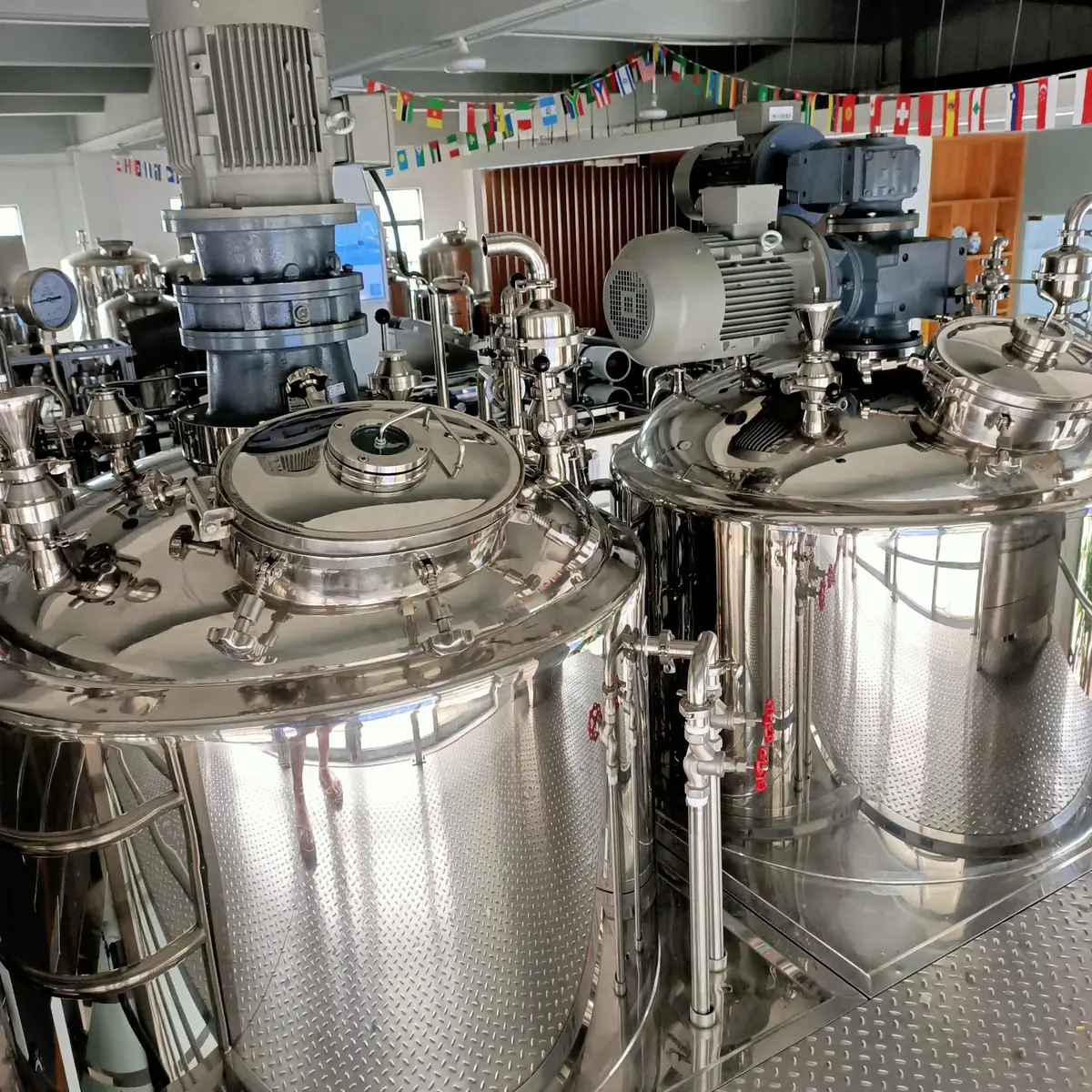
A bottom-entry homogenizer sits where hydrostatic pressure pushes product into the rotor. Paired with a slow anchor and wall scrapers, it keeps the whole batch cycling past the shear zone, so a 40-minute emulsification does not turn into a two-hour search for lumps.
If your supplier only offers a top head, ask at what viscosity the rotor still self-feeds. A figure below your target viscosity means the design depends on channeling, and channeling does not disperse powder. The same question list appears in our vacuum emulsifying mixer selection guide.
| Batch viscosity at process temperature | Homogenizer position | Agitator and scraper | What to specify |
|---|---|---|---|
| 5,000 – 15,000 毫帕·秒 | Top or bottom entry | Anchor with scrapers | Fill level and baffle position |
| 15,000 – 30,000 毫帕·秒 | Bottom entry preferred | Anchor plus wall scrapers | Rotor feed curve at target viscosity |
| 30,000 – 60,000 毫帕·秒 | Bottom entry | Heavy anchor, full-height scrapers | Starting torque at cold product |
| Above 60,000 毫帕·秒 | Bottom entry with recirculation loop | Twin shaft or planetary option | Discharge pump and drainability |
The table is a starting point, not a selection. The number that decides the design is your highest viscosity at the lowest temperature the batch will ever see, which is usually at start-up rather than at the end of the cook.
Where the Viscosity Number Comes From Before You Specify a High Viscosity Vacuum Emulsifier
Most quotations carry a viscosity limit such as up to 100,000 mPa·s with no temperature and no shear rate attached. Both matter. A sauce measured at 60 °C can read a fraction of its value at 25 °C, and a rotational viscometer at low shear reports a higher number than the product sees inside the homogenizer.
Ask for the measurement conditions in writing. When a buyer sends us a target, we ask for the highest viscosity at the coldest point of the process, because that is the condition where the anchor either turns or trips the drive.
A specification written at room temperature on a cooled sample describes a product you will never mix. It also hides the one number the gearbox has to survive.
Why a Lab Mixer Cannot Predict a 3,000 L Batch
一个 10 L laboratory unit and a 3,000 L production vessel are not the same machine scaled up. Torque demand rises with the cube of the impeller diameter, while jacket area per unit volume falls as the vessel grows, so a lab batch that emulsified in twelve minutes says little about the plant.
Scale-up should be argued on tip speed, torque per unit volume and jacket area per unit volume, not on mixing time. A supplier who offers a lab trial without those three calculations is selling a demo, not a design.
Decision 2: Torque, Not Kilowatts, Sizes the Anchor
一个 55 kW motor says very little about whether the anchor will turn a cold starch paste. Shaft torque, multiplied through the gearbox, is what decides whether the drive stalls on the first revolution, when the product is thickest and the scrapers are pressed hardest against the wall.
Ask for the starting torque at the gearbox output, the VFD torque limit setting, and the current at which the drive trips. A quotation that lists only motor power is describing an empty tank, not your batch.
Wall scrapers add drag that has to be carried in the same torque budget. A scraper pressed hard enough to keep the wall clean is also a scraper that resists rotation, so the drive margin covers both the product and the cleaning contact.
Decision 3: The Vacuum Port Cannot Deaerate What It Cannot Reach
Vacuum removes air only where product meets the gas phase. In a thick paste the exposed surface renews slowly, so deaeration time is set by how fast the scraper and anchor turn the film over, not by how deep the vacuum is.
That is why two tanks at the same vacuum level can behave completely differently. A full-diameter lid port above a scraped surface gives air a short path out. A small port at the centre of a static bulk gives it a long one, and the batch keeps its bubbles however long the pump runs.
Judge the design on exposed surface area and turnover rate before you accept any vacuum specification. If the supplier cannot describe how the surface is renewed, the vacuum figure is decoration.
Decision 4: Water Vapour Load, Not Air Leak Rate, Sizes the Pump
At minus 0.09 MPa water boils near 45 °C. Any water-based sauce held at 60 °C under that vacuum is evaporating, and the vapour is what the pump has to move. Sizing on air leak rate alone gives you a pump that pulls down quickly on an empty tank and falls over once hot product is inside.
The consequences reach the formula. Water lost to the vacuum raises solids, thickens the product further, and changes the viscosity you designed the agitator around. A batch that starts at 28,000 mPa·s can finish well above the number in your specification.
Ask for vapour tolerance, condenser capacity and the make-up water step in the recipe. Then check whether the control system compensates for evaporation or simply records the vacuum.
Decision 5: Heat Transfer Sets the Cycle Time
A jacket cannot heat a paste the way it heats water. The viscous boundary layer at the wall insulates the product from the jacket, so overall heat transfer falls sharply as viscosity rises, and the batch spends most of its time waiting for temperature rather than for shear.
Dimpled or half-pipe jackets help because they raise the jacket-side coefficient, but the wall film is still the bottleneck. Scrapers that continuously renew that film do more for cycle time than a hotter utility supply, which is why every high viscosity vacuum emulsifier we quote carries a scraper duty rating with the anchor.
Cooling is usually the longer leg. Going from 60 °C to 30 °C in a thick product takes far longer than the same drop in water, so jacket area and chilled water temperature should both be checked against your target cycle time, not against tank volume.
Decision 6: Discharge and Cleaning Decide Changeover Cost
Thick product does not drain. A bottom outlet with a positive displacement pump and a short, large-diameter line is the difference between a clean break and an hour of yield loss at every batch end. The same discharge arrangement carries over to the industrial salad dressing production solutions we build for emulsified sauces.
Cleaning works by wetting surfaces. In a paste line the risk sits in dead legs, in the homogenizer housing and under the anchor, where product stays after the tank looks empty. Specify drainability and a flush step before caustic, and ask where the cleaning liquor actually reaches.
Changeover cost is a design output, not an operator skill. A line that needs two hours of manual cleaning between SKUs will not run small batches profitably, however good the emulsification is. The hygienic criteria behind that judgement are set out in the 食品级搅拌罐标准 we build to, and they align with the 3-A Sanitary Standards used across dairy and food plants.
供应商审核清单: 5 Documents for a High Viscosity Vacuum Emulsifier
Every assembly that leaves our 8,000 square metre workshop in Guangzhou is pressure-tested and run-tested before shipment, and the record travels with the machine. That is the standard we apply when we audit other suppliers, so the list below is the one we hand to buyers.
- Viscosity and torque calculation sheet covering your highest viscosity at the lowest start-up temperature, with gearbox output torque and VFD limit stated.
- Homogenizer feed curve showing the viscosity at which the rotor still self-feeds, not just its maximum tip speed.
- Vacuum system sizing that includes vapour load and condenser capacity at your process temperature, plus the expected evaporation loss.
- Heat transfer calculation for the jacket area at your wall viscosity, with the assumed utility temperatures written down.
- Material and surface file: 316L contact parts, roughness measurement, and food-contact declaration for the gaskets and seals.
经常问的问题
Can a standard vacuum emulsifier handle a 40,000 mPa·s sauce?
Not without changes. A top-entry homogenizer loses feed at that viscosity, so the unit needs bottom entry, an anchor with wall scrapers and torque headroom at start-up. Without those three, the batch mixes slowly and unevenly rather than failing outright, which is harder to detect in a trial.
Does a deeper vacuum remove air faster?
不. Deaeration is limited by surface renewal, so a deeper vacuum mainly increases water evaporation. At minus 0.09 MPa water boils near 45 °C, which thickens the product and can push viscosity past the design point.
How full should the tank be run for thick product?
Leave enough free surface for the batch to circulate. Filling a paste tank to the nominal volume removes the space the anchor needs to turn product over, and the result is a dead zone at the top that no vacuum port can help.
How do we validate the design before paying the balance?
Run a factory acceptance test with your own formula at the highest viscosity and the lowest start-up temperature, and measure torque current, vacuum hold, batch time and discharge. A water trial proves the motor turns; it does not prove the line makes your product.
Send your formula viscosity, batch size and target cycle time through our engineering contact form, or message the team on WhatsApp at +86 138 2506 6178. We reply with the sizing sheet for the configuration we would build.