
 E-mail: info@guanyumixer.com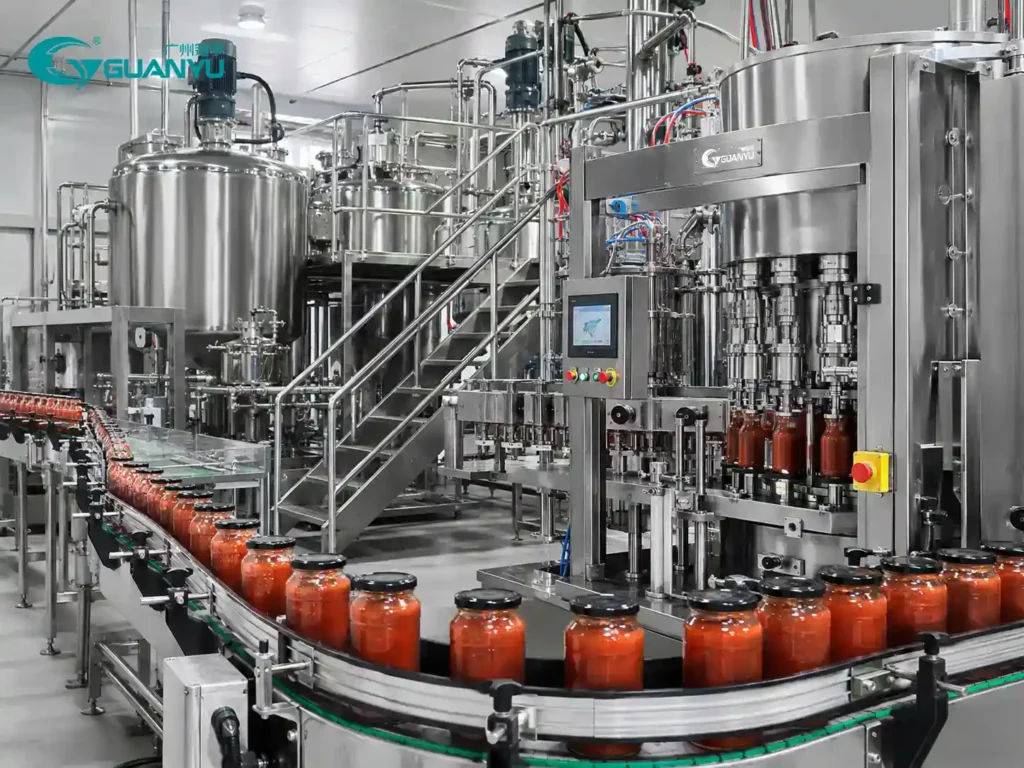
7 Proven Tomato Sauce Filling and Capping Line Checks
A tomato sauce line can lose hours at the filler even when the cooking and mixing stages are stable. Foamy product, inconsistent viscosity, dripping nozzles, cap misfeeds, and a poorly planned changeover usually point to a line designed machine by machine instead of as one process. This guide explains how to evaluate a tomato sauce filling and capping line around product behaviour, container choice, sanitation, and commissioning evidence.
Contents

What must be fixed before selecting a tomato sauce filling and capping line?
Define the sauce and the container together. Tomato sauce may contain pulp, seeds, particulates, or stabilizers, and its flow can change with temperature and shear history. The bottle, jar, pouch, or other container determines the neck finish, cap type, fill volume, closure torque, label position, and inspection needs.
Prepare a process data sheet that includes viscosity at filling temperature, density, particulates, target fill weight or volume, container dimensions, closure specification, products per minute, and planned changeovers. Without these inputs, a stated speed is not a reliable production promise.
- Product: temperature, viscosity range, particulates, foam tendency, and cleaning sensitivity.
- Container: material, neck finish, volume, dimensional tolerance, and surface condition.
- Closure: cap type, feeder orientation, torque window, seal or liner requirement, and tamper evidence.
- Operation: target output, operator count, batch transfer method, and changeover frequency.
We use this information to separate a filling problem from a sauce preparation problem. If the sauce reaches the filler with variable temperature or entrained air, changing the nozzle alone may not solve the reject rate. The line review must follow the product from the mixing tank to the sealed container.
How should you choose the filling method for tomato sauce?
The filling method should follow the sauce’s flow behaviour and the package’s accuracy requirement. Volumetric, piston, gear-pump, or other dosing arrangements can behave differently with shear-sensitive products, particulates, temperature changes, and long transfer routes.
Check the complete product path: holding tank outlet, pump, pipe diameter, valve, nozzle, and return or recirculation route. A narrow restriction can increase shear or pressure, while an oversized route can leave too much residual product during changeover.
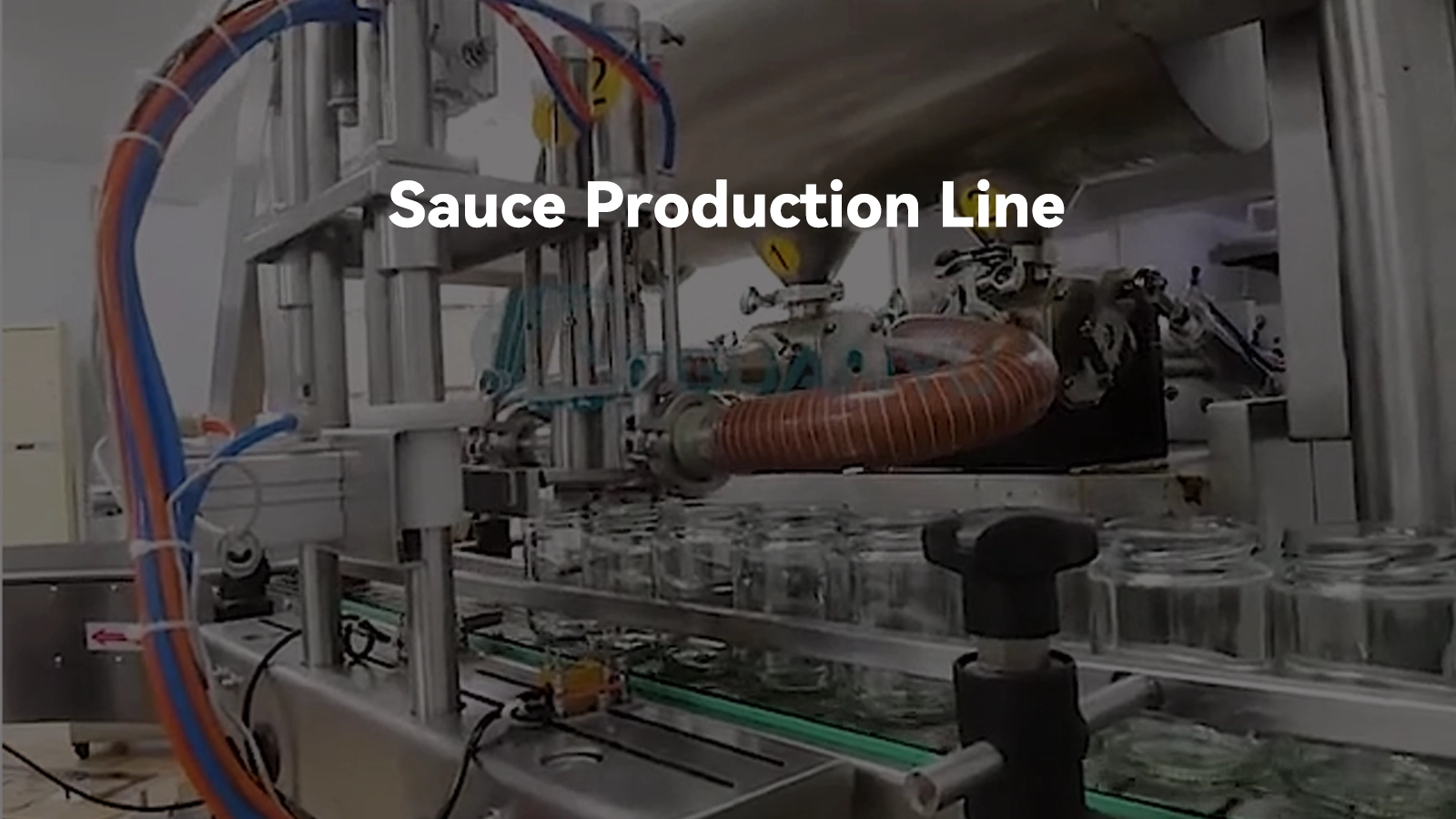
Guanyu supplies liquid filling equipment alongside mixing, storage, capping, labeling, and other packaging machines. The useful engineering question is how each hand-off is controlled: product level, transfer pressure, container position, dosing signal, and reject handling should be visible in the line sequence.
For a tomato sauce filling and capping line, this connected review matters more than a headline speed copied from a catalogue. Review the capping machine range with the filler rather than evaluating closure equipment separately.
| Filling concern | Typical engineering question | What to verify during a trial |
|---|---|---|
| Variable viscosity | Does the dosing system remain stable across the filling-temperature range? | Fill-weight trend at agreed temperatures |
| Foam or air | Where is air introduced or released before the nozzle? | Product appearance and nozzle behaviour |
| Particulates | Can the pump, valve, and nozzle pass the particle size without damage? | Continuous run with representative sauce |
| Changeover loss | How much product remains in the pipework and hopper? | Drainability and cleaning inspection |
How do you prevent capping and sealing problems?
Capping accuracy begins before the capper. Containers must arrive upright and consistently spaced, caps must be oriented and delivered without jams, and the bottle neck must be clean enough for the closure to seat correctly.
Define the closure torque or sealing window with the packaging supplier and test it on the actual container. Under-torque can create leakage or a weak seal; over-torque can damage the closure or make opening difficult. A capper selected only by containers per minute may not protect either requirement.
Review the cap chute, cap sorter, pick-up or placement method, torque head, cap-present sensor, and reject station as one system. If the line stops whenever a cap is misoriented, the control logic should stop safely, retain the batch status, and give the operator a clear recovery step.
What sanitation features should the line include?
Sanitary design is an operating requirement, not a decorative finish. Product-contact areas should be inspectable, drainable, and compatible with the cleaning method used at your site. The layout also needs to prevent sauce residue from collecting around valves, gaskets, transfer connections, and the filler manifold.
For food projects, review the applicable market requirements and hygienic design references early. The 3-A Sanitary Standards catalogue includes standards for fillers and sealers of fluid and viscous products, blending equipment, sanitary fittings, and installation and CIP practices. A supplier should identify which reference is relevant rather than placing a general logo on a quotation.
Guanyu builds mixing tanks and filling systems in SUS304 or SUS316L configurations according to the product and process requirements. Material selection is only one part of the review: ask for the contact-material schedule, seal materials, cleaning sequence, drain points, and the inspection method used before shipment. Link the answer to the tomato sauce filling and capping line’s actual cleaning and changeover plan.
How should mixing, filling, and capping controls be integrated?
A coordinated line uses signals between stages instead of asking an operator to balance every machine manually. Tank level, transfer readiness, filler status, container presence, cap availability, fault state, and downstream accumulation should be represented in the control logic.
Recipe control matters when the same factory makes tomato sauce, ketchup, dressings, or other viscous foods. The process parameters may differ, but the system should make the active recipe, alarm state, manual override, and restart conditions clear to the operator.
Guanyu’s one-stop project service covers equipment selection, plant layout, installation, commissioning, and process guidance. Our manufacturing base includes more than 800 technical staff, and our five-axis linkage machining capability supports the precision of selected equipment components; the final control sequence still needs to be tested against your own containers and sauce. The broader filling machine category shows how the packaging stage can be scoped alongside the capper.
What should you test before accepting the line?
Factory acceptance should use representative sauce, containers, caps, and labels whenever practical. Record the agreed fill target, observed variation, speed, stoppages, cap placement, torque or seal result, rejects, cleaning access, and alarm recovery.
Site acceptance should then repeat the critical checks under the customer’s utilities and operators. This distinction prevents a line from passing an empty-machine demonstration while failing with the product that creates the real production load.
- Run the sauce through the full transfer path at the agreed filling temperature.
- Check fill accuracy and appearance at startup, steady state, and after a controlled stop.
- Verify cap feeding, placement, torque or seal, cap-present detection, and reject handling.
- Inspect product-contact areas after the agreed cleaning cycle and record residual product.
- Review operator training, recipe access, spare parts, and fault-recovery instructions.
Supplier Audit Checklist: 5 Documents to Request Before Signing a Purchase Order
- Process and container specification: confirms the sauce properties, package dimensions, closure, and target output used for the quotation.
- Product-contact material and seal schedule: identifies stainless steel grades, gaskets, hoses, valves, and traceability records.
- FAT protocol and sample report: shows how fill accuracy, capping, alarms, and changeover will be judged.
- Cleaning and drainability drawing: allows your team to inspect dead legs, low points, spray coverage, and access before fabrication.
- Controls and service package: covers PLC sequence, alarm list, manuals, training, spare parts, warranty, and commissioning responsibilities.
Request these documents before comparing prices. A lower quotation can become more expensive when the filler, capper, utilities, cleaning method, and control logic must be redesigned after the order.
Frequently Asked Questions
Q: Can a tomato sauce line fill other products?
A: It may, if the product-contact path, dosing system, cleaning method, and recipe controls are suitable for the product family. Confirm viscosity, particulates, temperature, and changeover requirements before adding products to the scope.
Q: How do I reduce foam at the filler?
A: Trace the product path from the tank to the nozzle and check mixing, pump selection, pressure changes, leaks, drop height, and filling speed. A filler adjustment cannot correct air introduced upstream.
What information does a supplier need for a reliable quotation?
Provide sauce viscosity and temperature, particulates, container and cap drawings, fill volume, target output, utilities, cleaning method, and destination-market requirements. These inputs are more useful than a request for a generic “fast” line.
Q: Should the filler and capper be purchased as one project?
A: Treat them as one packaging interface even if the machines are priced separately. The container pitch, line speed, cap supply, sensor logic, and reject handling must be tested together.
Send us your sauce properties, container drawings, cap specification, target output, and cleaning requirements. We can review the tomato sauce filling and capping line as a connected process rather than a list of disconnected machines. You will then have a defined test plan for supplier discussions and factory acceptance.

Nice post. I learn something totally new and challenging on websites
[861438]supplies professional anti-violence equipments and solutions for the whole world with strong and perfect production capacity. anti-violence.org
You’re so awesome! I don’t believe I have read a single thing like that before. So great to find someone with some original thoughts on this topic. Really.. thank you for starting this up. This website is something that is needed on the internet, someone with a little originality!
Ezjili…mukhang madali lang ah! Hopefully, their platform is truly easy to use. Baka mas kumplikado pa sa exam. Wish me luck! Check out ezjili for yourself: ezjili
Super easy access and the loading speed is impressive. I love how everything is organized, making it easy to find my favorite games. Great vibes over at 991jililink.
Thanks for this information, very useful content.
Solid write-up, exactly what https://www.doujin-pc.org/ I was looking for.
Interesting read! Keep the quality posts https://www.34anime.com/ coming.
Helpful stuff, bookmarked for https://javhappy.site/ later. Thanks!
Naked womnen of rioHot teewn beastyalityMovie doubpe trouble pornBiggest adult websiteGay
trucksr hookup njSeexy histry professots aat uabErotic
fantsy wallpaperTeens fucking cucumbersPenis haning torture
xnxx Wwe divas nude cherryOrrgy pics porn freeMiss teen tennesseeAmazon penis pumpsBssb sexCentaur
bottom bracketsRoped nakedBigdick dewmo seex https://hiporn.cc Hony mature plump womanAmateur housewkfe upFrree blob pictureKyra nipples boobsFuckk thgem other
niggaz mp3What’s my sexual orientationMazaki nakedTeen hitchhiker
forcedGirls naked yacht xnxx Virus thaqt installs gay poprn shortcutSexy
bikini phto shootsYoer sexzual misconductWomn andd youung boyy sexTapping teen assesNasty public
fjsting humiliationMillfs all mmodels over 18 2257Wett pussy and dryy pussy
Really loving the slot variety here. I hit a decent win yesterday and the withdrawal process was a breeze. jilijiliph is my new go-to for daily fun.