
 อีเมล: info@guanyumixer.com
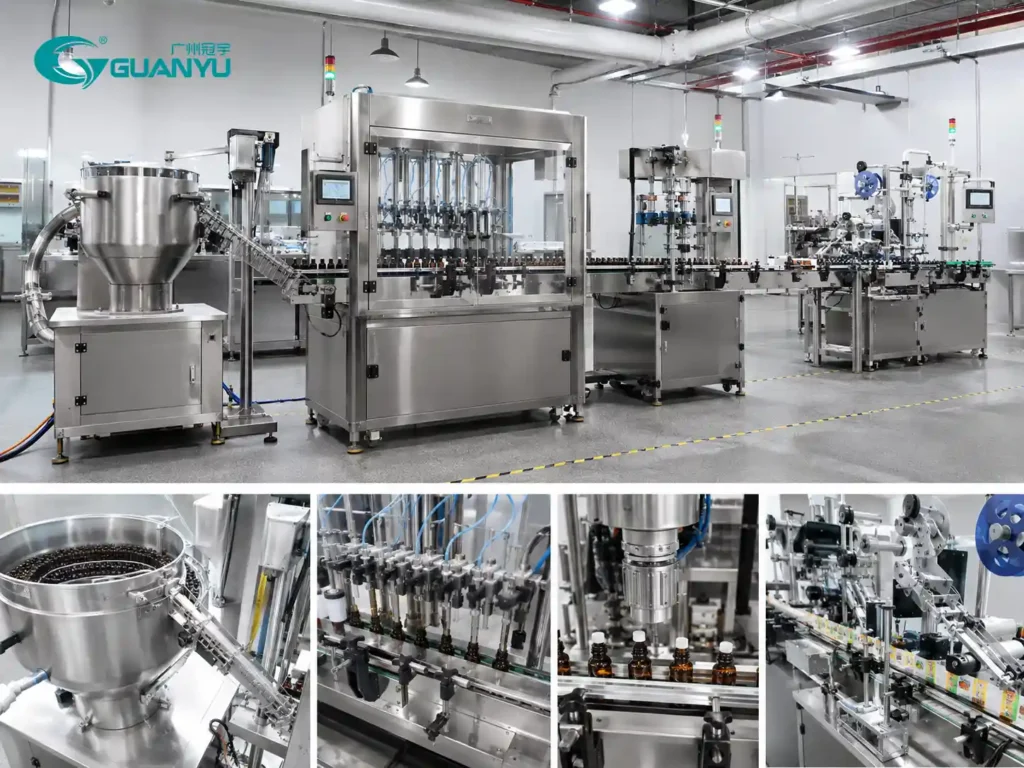
หากคุณเคยเผชิญกับการปฏิเสธเป็นชุดเนื่องจากซีลบริเวณคอดำคล้ำ, ส่วนเบี่ยงเบนปริมาณ, หรือรอยแตกขนาดเล็กในหลอดแก้ว, คุณเข้าใจถึงความเสี่ยงในการปฏิบัติงานของเครื่องจักรบรรจุภัณฑ์ที่ไม่ได้มาตรฐาน. The good news is that deploying a properly engineered automatic ampoule filling and sealing line transforms fragile glass handling into a dependable, การดำเนินการปลอดเชื้อซ้ำได้.
ในตัวเรา 30 years of manufacturing high-precision pharmaceutical and cosmetic machinery, we have engineered filling lines for production facilities across more than 100 ประเทศ. Liquid formulations ranging from sterile injectable pharmaceuticals to high-potency cosmetic serums require strict contamination control, precise gas flushing, and balanced flame sealing.
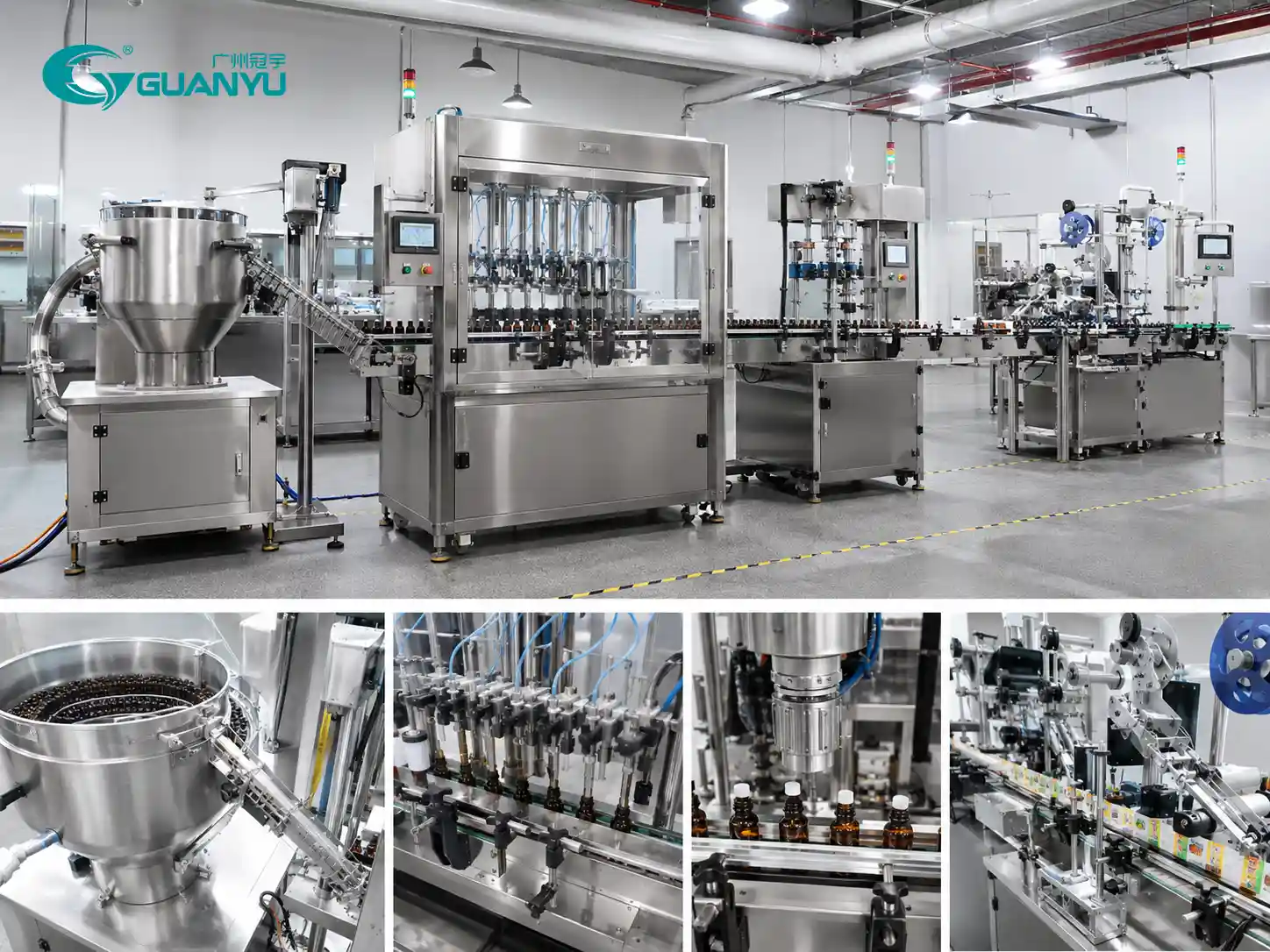
What Is an Automatic Ampoule Filling and Sealing Line and How Does It Work?
หนึ่ง automatic ampoule filling and sealing line is an integrated aseptic packaging system engineered to wash, sterilize, เติม, purge, and hermetically seal open-mouth glass ampoules without human intervention. The complete process operates under laminar airflow to maintain strict Class 100 / ISO 5 environmental cleanroom conditions.
Ampoules enter through an infeed screw that indexes each glass container into a precision stainless steel walking beam or rotary star wheel. Our engineering team designs these transport mechanisms using 5-axis CNC machining centers to ensure smooth movement without glass friction or micro-fractures.
Before dosing, a dedicated needle array introduces high-purity nitrogen gas to displace ambient oxygen and protect active ingredients from oxidation. Immediately following pre-gassing, servo-driven rotary ceramic piston pumps dispense liquid into the ampoule body before a second post-gassing cycle seals in nitrogen headspace.
The filled ampoule advances to the flame sealing station where gas-oxygen burners soften the glass neck while mechanical gripping tongs draw and twist the waste glass away. This coordinated motion produces a smooth, hemispherical dome seal with zero carbonization and uniform wall thickness across every batch.
Critical Engineering Challenges in High-Speed Ampoule Filling and Sealing
Operating an automatic ampoule filling and sealing line at speeds exceeding 12,000 ampoules per hour introduces complex mechanical and thermal variables. When evaluating equipment, factory engineers must look for specific mechanical designs that resolve three persistent production bottlenecks.
อันดับแรก, liquid wetting of the ampoule neck causes severe carbonization during flame exposure, creating black particles that trigger optical inspection rejections. In our manufacturing practice, we prevent neck wetting by utilizing servo-driven bottom-up filling needles with automated suction cut-off valves that eliminate trailing droplets.
ที่สอง, oxygen residue in sealed ampoules degrades sensitive active pharmaceutical ingredients and high-potency vitamins. In our 10,000-ampoule/hour continuous validation runs, dual-stage pre- and post-nitrogen purging at 0.15 MPa reduced residual headspace oxygen levels below 0.8% across all test vials.
Third, inconsistent gas-oxygen mixing ratios create uneven flame temperatures, leading to fragile bubble caps or sharp needle-point tips. We integrate digital mass flow controllers that maintain gas and oxygen pressure ratios within ±0.01 bar, guaranteeing uniform glass melting regardless of ambient factory pressure swings.
Key Technical Parameters and Configuration Comparison for Ampoule Lines
Selecting the right machine configuration depends on your target container volume (1ml to 20ml), required throughput, and cleanroom footprint. The table below details technical specifications across our standard industrial machinery range.
| Engineering Parameter | Compact 4-Needle Unit | Standard 8-Needle Line | High-Speed 16-Needle System |
|---|---|---|---|
| ผลผลิต (1-2มล) | 3,000 – 4,500 pcs/hour | 8,000 – 10,000 pcs/hour | 18,000 – 24,000 pcs/hour |
| Filling Volume Range | 0.5 มล – 20 มล | 1.0 มล – 20 มล | 1.0 มล – 10 มล |
| Dosing Precision (Piston/Ceramic) | ±0.8% standard | ±0.5% servo-controlled | ±0.3% ceramic rotary valve |
| Residual Oxygen in Headspace | < 1.5% | < 0.8% with dual purge | < 0.5% with triple purge |
| Sealing Burner Fuel Support | LPG / Natural Gas + O2 | LPG / City Gas + O2 + อากาศ | Premix Digital MFC Gas/O2 |
| Material Grade (Contact Parts) | SUS316L (Ra ≤ 0.4 ไมโครเมตร) | SUS316L (Ra ≤ 0.28 ไมโครเมตร) | SUS316L + Ceramic Piston |
For facilities running diverse product categories, upstream integration with sterile pharmaceutical mixing tanks ensures consistent fluid pressure and temperature delivery to the filling manifold without pulsation. This closed-loop fluid delivery prevents cavitation in high-speed dosing pumps and maintains uniform liquid temperature throughout multi-shift production runs.
GMP and Cleanroom Compliance: Nitrogen Purging and Laminar Airflow Integration
Compliance with international health authority standards requires full aseptic boundary integration. When integrating an automatic ampoule filling and sealing line into your cleanroom, all mechanical drive assemblies must sit completely isolated beneath the sanitary working deck.
In our equipment designs, the filling and sealing zone interfaces directly with Class 100 laminar airflow (LAF) hood modules or barrier isolation systems (RABS). The sanitary deck features 316L stainless steel with radiused coved corners, eliminating dead zones where glass dust or moisture could accumulate.
Liquid contact circuits support automated Clean-In-Place (เหล็กกล้า) and Steam-In-Place (จิบ) routines operating at 121°C for 30 minutes without requiring manual teardown. As outlined in the FDA cGMP sterile manufacturing guidelines, automated barrier isolation and validated clean-in-place routines represent the industry benchmark for batch integrity.
This sanitary architecture also benefits high-end cosmetic brands producing sterile essences, seamlessly complementing our GMP-compliant skincare production lines และ pharmaceutical syrup manufacturing process ระบบ. It allows multi-product facilities to maintain strict sanitary segregation while maximizing equipment utilization across diverse liquid viscosity ranges.
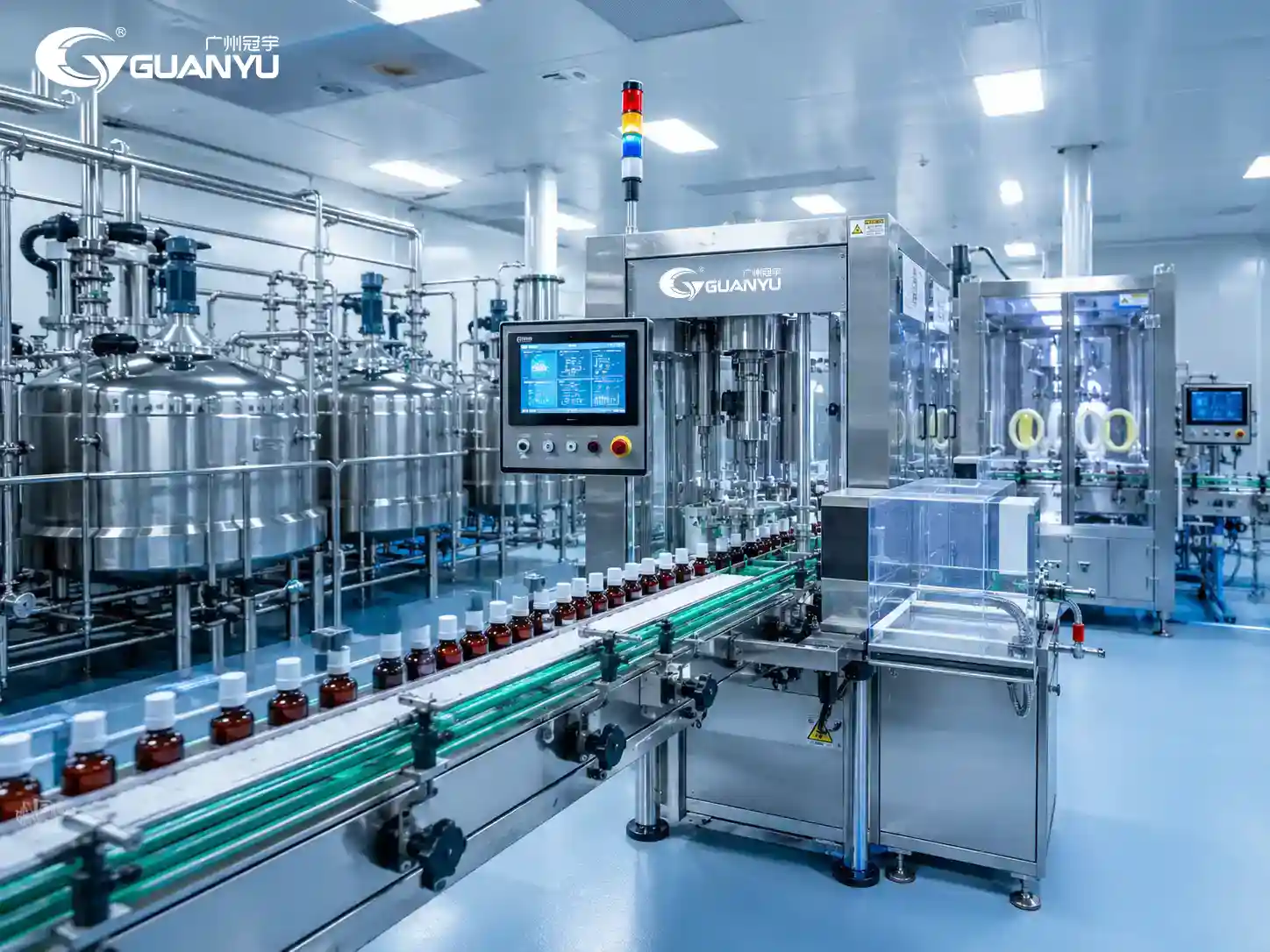
How Our 5-Axis Precision Machining Eliminates Mechanical Vibration and Seal Defects
Machine longevity and ampoule seal quality depend heavily on the dimensional tolerances of walking beam linkages and cam transmission drives. ใน 2021, we invested in advanced 5-axis CNC machining centers to produce our core mechanical indexing components in-house.
Machining walking beam carriers from solid 304 and 316L billets allows us to achieve geometric positioning tolerances within 0.015 มม. In our high-speed factory endurance tests running continuously for 120 hours at 12,000 ampoules per hour, mechanical vibration remained below 1.2 mm/s RMS, reducing glass breakage to less than 0.02%.
Every component on our automatic ampoule filling and sealing line undergoes full coordinate measuring machine (CMM) inspection before assembly. This structural rigidity ensures that flame burner needles remain perfectly centered on rotating ampoule necks, preventing lopsided melt profiles and uneven glass stresses.
Supplier Audit Checklist: 5 Documents to Request Before Ordering an Ampoule Line
Before signing a commercial purchase order or releasing project milestone payments for your packaging machinery, demand the following technical verification documents from your equipment manufacturer. A qualified machine builder should provide comprehensive test certificates and validation protocols without hesitation:
- 1. Material Test Certificate (MTC 3.1) confirming genuine SUS316L alloy composition with electropolished surface roughness Ra ≤ 0.28 μm for all liquid contact paths.
- 2. Complete FAT/SAT Validation Protocol Templates covering Design Qualification (ดีคิว), คุณสมบัติการติดตั้ง (ไอคิว), and Operational Qualification (โอคิว) กับ 21 CFR Part 11 electronic audit trail compliance.
- 3. Nitrogen Purging and Oxygen Headspace Test Report demonstrating residual headspace oxygen levels below 1.0% under simulated production speeds.
- 4. High-Speed Flame Sealing Uniformity and Annealing Stress Report verifying seal wall thickness consistency and glass thermal stress compliance under polarized light inspection.
- 5. CMM Machining and Cam Tolerance Inspection Sheets verifying mechanical indexing repeatability and vibration metrics under full-load operation.
คำถามที่พบบ่อย: Common Questions on Automatic Ampoule Filling and Sealing Lines
What is the typical glass breakage rate on an automatic ampoule filling and sealing line?
On a well-engineered production line, the glass breakage rate should remain below 0.05% during regular operation. ที่กวนอู, our 5-axis machined indexing carriers and soft-start servo star wheels routinely achieve glass breakage rates under 0.02% in commercial production. When auditing potential suppliers, verify whether their transport stars use precision POM guides and synchronized servo indexing.
How does the machine handle different ampoule sizes from 1ml to 10ml?
Switching between ampoule sizes requires a quick-change format tool set comprising infeed screws, star wheels, walking beam nests, and needle spacing blocks. Our format parts feature tool-free quick-clamping fixtures, allowing two trained technicians to complete a full size changeover and optical recalibration in under 45 นาที. Always ask suppliers for video evidence of full changeover routines before placing an order.
Which dosing pump technology is best for heat-sensitive and shear-sensitive biological liquids?
Valveless rotary ceramic piston pumps provide the highest dosing precision (±0.3% to ±0.5%) while eliminating friction wear particles and shear stress. For biological solutions or live cultures, our engineering team configures high-precision peristaltic dosing heads with disposable single-use platinum-cured silicone tubing to eliminate cross-contamination. Request a fluid compatibility review from your machine builder prior to pump selection.
Can the ampoule filling machine be integrated with an upstream depyrogenation tunnel?
ใช่, industrial ampoule lines are engineered to dock directly with ultrasonic washing machines and hot-air laminar flow depyrogenation tunnels. In our integrated turnkey projects, ampoules travel continuously from depyrogenation cooling zones into the Class 100 filling chamber under uninterrupted positive air pressure. Ensure your equipment vendor supplies integrated PLC handshaking protocols between all upstream and downstream units.