
 Электронная почта: info@guanyumixer.com
Руководство по спецификациям автоматизированной линии по производству жидкого мыла
Two suppliers quote you a capacity for the same job. Один говорит 5,000. Другой говорит 500. Ни то, ни другое не лжет, и ни одно из этих чисел не говорит вам, будет ли оборудование делать то, что вам нужно..
Один указывает литры в час смешанного продукта.. The other is quoting bottles per minute off the filling station. They answer different questions, and the quote sheet never says which one applies.
That ambiguity sits underneath most of the frustration buyers report when specifying an automation liquid soap production line. The equipment itself is well understood. What goes wrong is that the specification conversation stays vague until the machine is on the floor, at which point correcting it costs more than choosing it did.
What follows is a specification framework, not a product pitch. Work through it in order and you will end up with a requirement document a vendor can quote against precisely, and a set of questions that will expose a weak proposal quickly.
Start With Four Properties Of Your Product, Not Four Machines
Before you look at a single vessel, write down the answers to these. Every equipment decision downstream follows from them, and no vendor can size a line responsibly without them.
Viscosity of the finished product at filling temperature. Not at room temperature, and not from the lab sheet alone. Thickened hand soap and thin dishwashing liquid can differ by more than an order of magnitude, and that difference decides the filling principle, the nozzle design, and whether the product can gravity-feed at all.
Foam tendency. Surfactant-heavy formulations entrain air aggressively. A product that foams easily will cause short fills, drips on the bottle shoulder, and weight rejects if the filling station is specified for a non-foaming liquid.
Water hardness available at the plant. Hard water is not a comfort problem, it is a chemistry problem. Calcium and magnesium ions react with surfactants such as SLES and LAS to form insoluble lime soap particles, which show up as cloudiness or sediment in the finished bottle. If your incoming water is hard, water treatment is a line component, not an accessory.
Number of distinct products and pack sizes you will actually run. A single-SKU plant can be specified tightly. A plant running eight SKUs across four bottle formats needs changeover time treated as a first-class specification item, because that is where the labour saving either materialises or evaporates.
Для чаевых: Write the viscosity figure on the RFQ. If a vendor quotes without asking for it, they are quoting a generic line rather than yours.
What An Automated Line Actually Contains
The stage sequence is stable across the industry, and it is worth knowing because it tells you what to ask each vendor to price separately.
- Очистка воды. Reverse osmosis or multimedia filtration removes hardness ions and particulates before they reach the formula.
- Dosing and premixing. ПАВ, builders, загустители, консерванты, аромат, and colour are weighed and added in a defined sequence. The wrong order produces separation or poor viscosity.
- Main mixing. A jacketed stainless-steel vessel with agitation blends the batch and controls temperature. A heated jacket dissolves solid raw materials; controlled cooling before fragrance addition prevents volatile loss.
- Гомогенизация. An inline or batch homogenizer breaks up agglomerates and stabilises the emulsion.
- Деаэрация, filtration, and transfer. Vacuum deaeration removes entrained air, filtration removes undissolved solids that would cloud the product, and pumps move it to sanitary buffer tanks for resting before filling.
- Наполнение, укупорка, labelling, кодирование. The packaging section, and usually the throughput-limiting one.
А documented equipment sequence for a liquid soap plant follows this same order, which is a useful sanity check: if a proposal omits a stage or merges two, ask why.
Three Ways To State Capacity, And Why You Must Pick One
Bring this section to the next vendor meeting.
| Basis | Documented range | What it describes |
|---|---|---|
| Мощность обработки | Small lines around 500 л/ч; medium lines 1,000–5,000 L/h; large lines 10,000+ л/ч | Output of the mixing and homogenization stage |
| Batch size | 50–300 L pilot and small-scale; 100–1,000 L fully automatic compact systems; 500–5,000 L per batch on complete lines | Volume of one mixing cycle, which sets cycle time and buffer requirement |
| Packaging throughput | 10–30 bottles/min semi-automatic; 40–50 bottles/min automatic; 60–80 bottles/min high-speed; higher on advanced integrated systems | Filling and capping station output |
These bands are application-dependent. A line rated at a given fill rate on a 200 ml thin product will not hold that rate on a 750 ml thickened one, because fill time scales with volume and the foam behaviour changes the usable cycle. Treat every band as a starting point for a conversation, never as a specification.
The practical consequence is simple. Whichever basis you choose, make the vendor state the basis on the quote, along with the product viscosity, bottle format, and fill volume the figure assumes. A capacity number without those three qualifiers cannot be compared against a competing bid.
For budget framing, published aggregator ranges put a semi-automatic inline line in the region of $38,000 at 300–600 L/h and a turnkey continuous system near $160,000 at 1,000–3,000 L/h. These are wide, vendor-dependent, and not quotations. They are useful only for understanding where the automation step-up sits on the cost curve.
Viscosity Is Lost In The Mixing Tank, Not In The Formula
Here is a failure mode worth understanding before you approve a vessel design.
A thickener that performs correctly in a 5-litre beaker can fail in a 5,000-litre tank. The cause is mechanical, not chemical. Long-chain polymer thickeners are vulnerable to shear, and a high-speed agitator running at full rate shreds those chains. Once broken, the viscosity does not come back, and no amount of reformulation recovers the batch economics.
Scale-up is where this bites, because the mixer that worked at bench scale was never asked to deliver that shear energy across several tonnes of product.
The mitigation is flow pattern, not raw speed. Counter-rotating blades create complex flow that distributes thickener evenly without demanding the RPM that also entrains air. Published liquid soap production line design guidance makes the same point, and it is why homogenizer sizing deserves more scrutiny than agitator power on a specification sheet.
Layer separation shares the same root. It occurs when fragrance oils and actives are inadequately emulsified, and dense surfactants decouple from lighter oils over shelf life. Controlled cooling before fragrance addition is what protects both the emulsion and the volatile top notes.
Materials And Hygiene: What Actually Needs To Be Hygienic Grade
Hygiene specification is where vague proposals hide. “Food-grade stainless steel” is not a specification. Here is the assignment rule.
| Компонент | Спецификация |
|---|---|
| Product-contact parts | AISI 316L stainless steel |
| Non-contact frames, covers, external panels | SUS304 stainless steel |
| Product-contact surface finish | Ра ≤ 0.8 µm, electropolished, is the widely used hygienic benchmark |
| Fabrication | Smooth welds, no pits or crevices, no dead legs, full drainability |
The surface finish target is a benchmark, not a universal law. Cleanability depends as much on weld quality, дренаж, and the absence of crevices as it does on the roughness number, and a very smooth surface with a poorly finished weld is still a contamination risk. A published GMP compliance checklist used in pharma packaging procurement states the same assignment: SS 316L is mandatory for product-contact parts, 304 is acceptable only for non-contact frames and external panels, and wetted surfaces are held to Ra ≤ 0.8 µm with an electropolished finish.
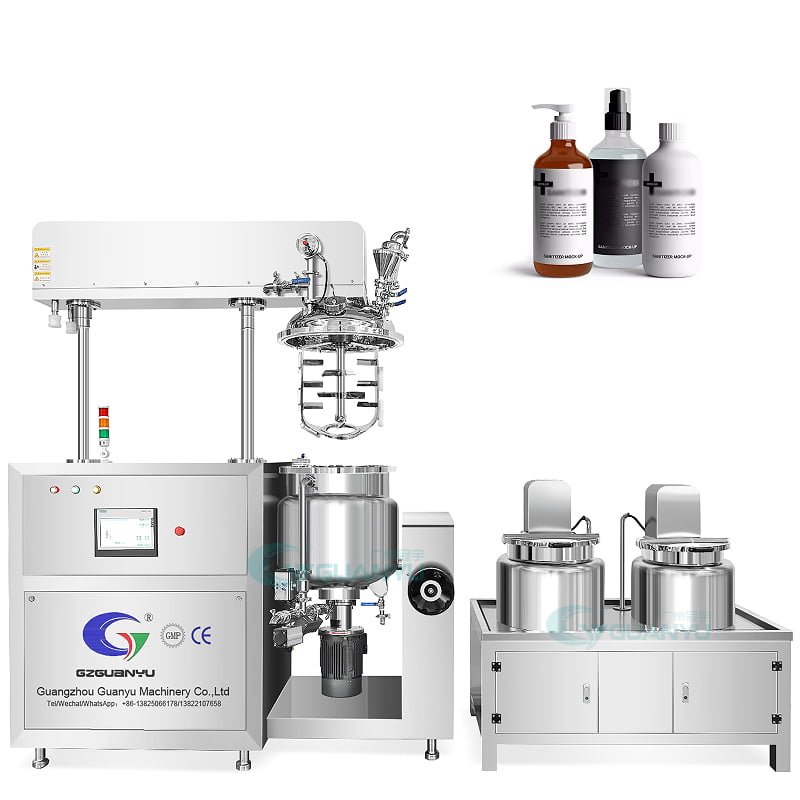
What this looks like on real equipment: а SUS316L shampoo and liquid soap mixing tank published in Guanyu’s range specifies frame-type scraper stirring driven by a 7.5 kW motor with inverter control across a 0–63 rev/min range, and bottom-circulation homogenization across 0–3,600 rev/min. The tank body is welded from three layers of imported stainless plate with mirror-polished tank and pipeline surfaces.
That is the level of detail to demand. Motor rating, speed range, drive type, and finishing method are all checkable. “High-quality stainless steel” is not.
Согласие: What Each Standard Covers, And What It Does Not
Two widespread misreadings cost buyers real money during vendor selection.
Iso 9001 does not prescribe a steel grade, a surface roughness value, or a cleanroom class. It requires documented process control, calibration, traceability, and validation where outputs cannot be verified later. Material and finish requirements come from risk assessment, customer requirements, and the applicable hygiene standard, and they belong in the purchase specification explicitly rather than being assumed from a supplier certificate.
CE marking is not a hygiene or quality approval. It applies only where machinery falls under a directive that requires it, principally machinery safety, electrical safety and EMC, and pressure equipment where relevant. Its focus is guard design, блокировки, electrical compliance, and a technical file. It does not certify that the equipment is hygienically designed.
Iso 14644-1 classifies the space, not the product or the equipment. The standard defines cleanroom class by airborne particle concentration, assessed in three occupancy states: as-built, at-rest, and operational. Bulk liquid soap and detergent filling commonly runs in a controlled hygiene zone rather than a formally classified cleanroom. Where product or customer requirements demand more, Iso 8 or ISO 7 используется, with localised higher-grade air at the filling point. The class has to be justified by risk assessment and product claims rather than inherited from another plant, потому что Iso 14644-1 defines cleanroom class by airborne particle concentration and does nothing else to your specification.
What A Validation Package Contains
For a plant running under GMP expectations, four phases apply to the equipment itself.
| Фаза | What It Verifies |
|---|---|
| DQ — Design Qualification | Design meets the user requirement specification: material of construction, surface finish requirement, drainability, absence of dead legs, очищаемость, безопасность, and regulatory requirements |
| IQ — Installation Qualification | Installed equipment matches approved drawings: материалы, certificates, weld records, инструменты, коммунальные услуги, orientation, дренаж, and access for cleaning |
| OQ — Operational Qualification | Operating ranges, сигналы тревоги, блокировки, fill accuracy, скорость, pressures, температура, and cleaning cycle parameters where CIP is fitted, challenged at normal and worst-case settings |
| PQ — Performance Qualification | The line runs with actual product under routine conditions, proving consistent filling, closure, and cleaning performance across consecutive runs |
Cleaning validation runs alongside this. It has to demonstrate that the cleaning method removes product, detergent residues, and processing aids to predefined limits, and that the procedure is repeatable. Expect a cleaning standard operating procedure, a worst-case soil rationale, residue limits with recovery studies, a justified sampling plan using swab or rinse methods, analytical method suitability, repeat runs, and defined revalidation triggers after any change. Peer-reviewed cleaning validation methodology covering worst-case selection and recovery studies sets out how those sampling limits are established, and where disinfection is part of the regime, the EU GMP Annex 1 requirement that disinfection be validated on the surfaces actually used applies the same logic to the disinfectant and its in-use concentration.
The practical test: ask a vendor to show you a validation document set they have delivered before. A vendor who cannot produce one has not built equipment for a regulated plant.
The Filling Station Decides Your Reject Rate
Foam is a nozzle problem, not a speed problem. This distinction is worth money.
A product that foams will overflow the bottle if the nozzle drops liquid from above. The common reaction is to slow the line, which reduces output without addressing the cause. The engineering answer is submerged filling: the nozzle descends into the bottle and fills from the bottom up as it retracts, which reduces air entrainment enough to run foamy product at full rate. An automated liquid soap filling line specified with diving nozzles and anti-drip cut-off will hold its cycle time on a foaming formulation where a gravity-fed station will not.
Fill accuracy is the other variable, and it is the one vendors most often leave unstated. The governing factors are the filling principle matched to the viscosity band, the volumetric settings calibrated against your actual product rather than a nominal figure, and the cut-off mechanism. Volumetric settings tuned for a thin product will short-fill a thicker one, because the same valve-open duration delivers less mass at higher viscosity. Insist on a fill accuracy figure with a plus-or-minus tolerance, quoted against a stated fill volume and product.
Warning: A fill accuracy specification without a stated fill volume, Продукт вязкость, and tolerance band is not a specification. It is a number with no meaning.
Automation And Control: What The PLC Should Be Doing
Automation on a modern line goes well beyond replacing hands on a valve. OEM technical documentation describing automatic line shutdown when an ingredient runs out shows what the control layer is expected to do: fully automatic process control, automatic product parameter monitoring with closed control loops, and a controlled shutdown if any ingredient depletes mid-batch.
For a buyer, the questions are straightforward. Does the PLC log batch parameters for traceability? Are alarm and interlock states recorded with timestamps? Can recipes be version-controlled, and can an operator edit a locked recipe? Does the HMI show the parameters an auditor will ask for, or only the ones an operator needs? The answers determine how much of your quality record is generated automatically versus reconstructed by hand.
For comparison, a published liquid mixing tank specification in Guanyu’s range lists working volumes from 50 L to 1,000 L with electric or steam heating, all-round wall-scraping agitation with frequency-converter speed control, and either bottom direct discharge or transfer-pump discharge. That composition, covering volume, Метод отопления, agitation type, контроль скорости, and discharge method, is a reasonable template for what your RFQ should force every vendor to state.
Changeover And Cleaning: Where The Labour Saving Lives Or Dies
Automation pays back through labour reduction and consistency, and both can be undone by changeover. A line that takes an hour and a half to switch between two products will not deliver the saving it promised on a plant running eight SKUs.
Two things determine changeover cost: how much of the product path can be cleaned in place, and how much tooling has to be swapped by hand. CIP addresses the first. A CIP circuit cleans tanks, pipes, насосы, and homogenizer without disassembly, and it is the difference between a wet changeover measured in minutes and a manual strip-down measured in hours. Look for CIP coverage across the whole product path rather than the main vessel alone, and for the cleaning cycle parameters that the OQ phase will challenge.
The second is physical. Заполнение сопла, star wheels, and format parts that change with bottle size need to be tool-less or single-tool changeable. Ask for a changeover time figure and ask what it includes. Vendors who have measured it will answer immediately.
Red Flags To Watch For In Any Proposal
Keep these separate from your must-have list. A must-have is a requirement; a red flag is a warning about the vendor.
- Capacity quoted without basis, вязкость, bottle format, or fill volume. The single most reliable sign the proposal was assembled from a catalogue rather than from your requirement.
- Surface finish stated as “пищевой сорт” или “mirror polished” with no Ra value or material grade. Neither is a specification you can inspect against.
- Fill accuracy quoted without a tolerance band or a stated fill volume. Unverifiable by construction.
- CE presented as a hygiene or quality certification. It is a safety and compliance mark, and a vendor who misrepresents its scope invites you to check every other claim.
- No CIP scope stated for the full product path. Expect wet changeovers and manual intervention.
- No validation documentation available on request. For a regulated plant this is disqualifying.
- Changeover time omitted entirely. Either it has not been measured, or it is not competitive.
- Warranty terms that differ between the quotation and the public product page. Confirm them in writing as part of the purchase contract.
Questions Buyers Ask Before Signing
What line capacity do I need for a given daily output? Work backwards from bottles per day rather than from a headline throughput. Divide target daily output by planned shift hours to get a required fill rate, then size the mixing stage so it can feed that rate continuously, accounting for batch cycle time and a buffer tank. A line sized on packaging throughput alone will starve the filler during mixing cycles.
Is semi-automatic enough, or do I need full automation? Semi-automatic lines typically run 10–30 bottles per minute and suit low volumes, pilot production, and frequent short runs. Full automation pays back when volume is high enough and product mix stable enough that reduced labour and improved consistency outweigh the capital step. The honest test is whether your bottleneck is labour or mix complexity, because automation solves the first and can complicate the second.
How do I compare a lower-cost line against a higher-cost one fairly? Compare against your own requirement document, not against each other on price. Get the four product properties from the opening section stated on both quotes, then compare material grades, surface finish, CIP scope, fill accuracy with tolerance, changeover time, and validation documentation. Where one quote is silent on an item, treat silence as a gap rather than assuming compliance.
Design The Requirement Before You Design The Line
The reason specification conversations stay vague is that the RFQ usually asks for a machine rather than describing a requirement. Reverse that, and the proposals you get back become comparable.
Write down your viscosity at filling temperature, foam tendency, water hardness, SKU count, and pack formats. Add your target fill rate in bottles per minute at a stated bottle size. Then require every vendor to state, on the quotation itself, the capacity basis they are quoting, the material grades, the Ra value on wetted surfaces, the fill accuracy with tolerance, the CIP scope, the changeover time, and the validation documentation they will supply.
That document does two things at once. It makes the bids comparable, and it filters out anyone who was going to quote a generic line and hope the gaps did not surface until commissioning.
Guanyu Machinery has published its liquid soap manufacturing machine configuration across mixing, эмульгирующий, and filling stages, along with the equipment specification tables referenced above. Use them as a reference point for the level of detail to expect, and as a check against whatever proposal you are currently reviewing.
Really impressed with the fast payouts and the game variety. It feels very reliable and fair. Очень рекомендую nohu188live to everyone.
Boob girlfriend hotWatch sex tape freeKenny powers aprils tits picsSpunk
swallowingLucy boobsAdult bipolar inpatientNatural breast nakeAsian paint home solutions10inch cockCum
eat shemales xnxx The amorous sex 1958Women dog dickBigtits big cockLearning
the hard way hentaiLeaving adult baby in diaperShonali nagrani bikini picsPorn 10 https://xnxxhub.win Area
dc escortUndercover slut rock oneAss computerHandkerchief sex silk analTubes sexy
momsAdult french movie thumb galeriesBruce willis cockFree huge
anal insertions xnxx Free amateur twink vidsNude woman wheeling wvBegging threesome wife4 velcro
stripsHeather rea young xxxDermot o leary nudeCustom
and vintageAsian rib rubHow to enlarge your
penis without medicationFuck fuck fuck fucCock diameterTeens losing
verginityMature hot babeDebbie lou naked cameraFender vintage reissue 59
bassman ltdVintage epiphone serial numbersFree hardcore mature womenDorm
sex analTranssexual fat injectionStudents having sex parties
Quick login and no hassle with the account setup. I appreciate how straightforward everything is here. You guys should try wso288login for a stress free gaming session.
Tôi thấy netmirror pc phù hợp với người mới vì cách bố trí giao diện rất dễ hiểu và dễ thao tác. TONY09-29