
 E-mail: info@guanyumixer.com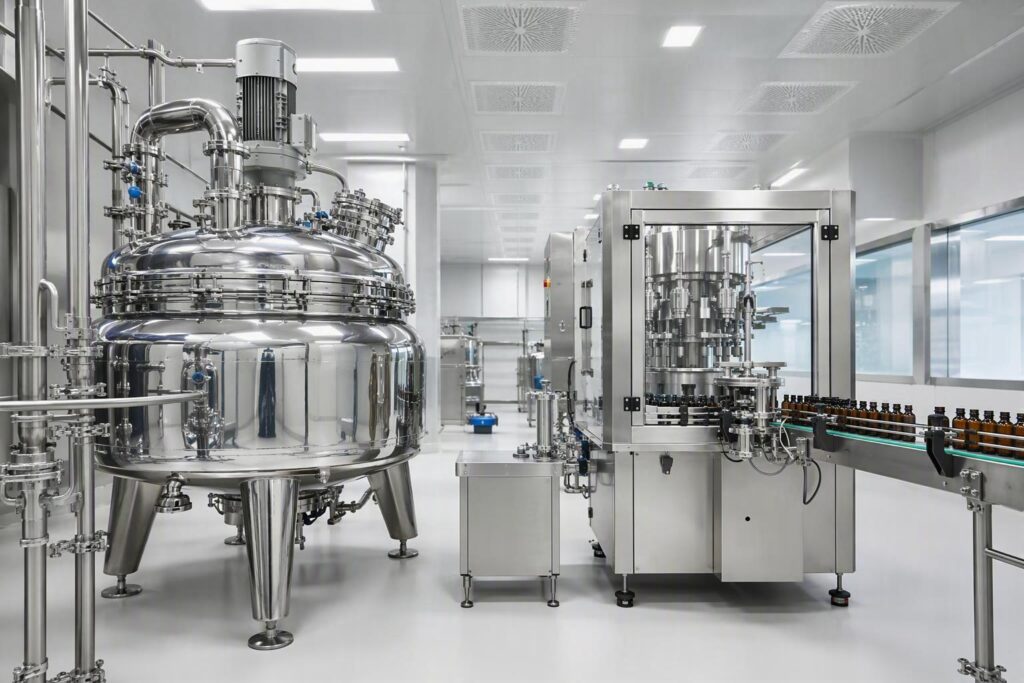
Lignes de production pharmaceutique personnalisées: Comment le projet One Line a été spécifié, Construit, and Validated
A mid-sized manufacturer had eleven months to move three products onto one line. Une crème médicamenteuse, un gel topique, et un mélange de poudres pour un format sachet. Deux d'entre eux étaient déjà au catalogue. Le troisième était à dix-huit mois du lancement.
Every pharmaceutical production line is a negotiation between what the product needs and what the building allows. Most projects discover the terms of that negotiation late, after the purchase orders are signed. This project discovered them in week two, which is the only reason it finished on schedule.
What follows is a composite account of how a customized pharmaceutical production line was specified, built, and qualified. The manufacturer is hypothetical, assembled from requirements that recur across real semi-solid and powder-blend projects. Everything else, including the standards, the specifications, and the sequence of decisions, is real. And the sequence is the part that matters. Get the order wrong and you pay for it twice: once in engineering changes, and again in validation scope.
A customized pharmaceutical production line starts with the validation package
The instinct is to open a catalogue and count machines. The manufacturer’s quality director pushed back on that within the first week, and he was right.
Before anyone sized a vessel, the team wrote down what the finished line would have to prove. That list looked like this: a validation master plan, user requirements with design qualification, factory and site acceptance testing records, installation and operational and performance qualification protocols, process validation covering mixing and homogenization and filling and packaging, cleaning validation with a worst-case rationale, environmental monitoring, calibration and change control, and complete batch manufacturing and packaging records.
Nothing on that list is exotic. What turns a set of process machines into a pharmaceutical manufacturing line is that every item on it must be produced, signed, and traceable before the first commercial batch ships.
That list is not paperwork bolted onto the end of a project. It is the specification, and every item on it changes what you buy.
The clearest example is control software. Off-the-shelf equipment typically arrives as a GAMP 5 Catégorie 3 ou 4 système, which carries a comparatively bounded validation burden. Modify that equipment for a specific process and you can push it into Category 5, which fundamentally changes what must be documented and re-verified. One manufacturer’s discussion of custom machine builds versus off-the-shelf equipment sets out that shift plainly, and it reframes the entire cost conversation. A cheaper machine that drags a Category 5 validation program behind it is not a cheaper machine.
Pour la pointe: Write your validation scope before you write your equipment list. The document you are dreading is actually the requirements document you were going to need anyway.
Why three catalogue machines could not become one line
The first plan was to buy three standard units and duct them together. It failed on integration, not on capability.
Each machine was fine in isolation. Together they produced three problems. The cream and gel differed enough in viscosity that a single filling head behaved acceptably on one and dripped on the other, because the fluid behaviour at the nozzle was never the same. The powder track needed dust control during charging that none of the standard configurations addressed, since airborne powder during manual charging is both a cross-contamination route and an operator exposure route. And the control systems spoke three different dialects, so batch records had to be assembled by hand from three logs.
None of these are exotic failures. They are the ordinary reasons that the full range of pharmaceutical production equipment built as a catalogue cannot simply be assembled into a compliant line. Integration gaps between process equipment and the systems above it, MES and quality and ERP among them, are among the most common sources of post-installation rework, and each workaround added during commissioning narrows the operating window you were counting on. This is the point where pharmaceutical production line design stops being an equipment-selection exercise.
There is also a threshold worth knowing. Once a catalogue machine must be modified beyond roughly a quarter to a third of its purchase price, the economics usually flip toward purpose-built equipment. Below that line, modification is often the faster and cheaper route. Above it, you are paying custom prices for a standard machine’s limitations, which is the worst of both arrangements.
The four constraints that decided the design
With the validation scope written and the catalogue route ruled out, the team reduced the project to four constraints. Everything downstream flowed from them.
| Constraint | Measured value | Design consequence |
|---|---|---|
| Product matrix | 2 semi-solid products plus 1 powder blend | Two process tracks sharing one facility, one utilities set, one cleaning regime |
| Batch-size spread | Wide range across the portfolio | Vessels sized for the smallest credible batch that still meets the largest product’s mixing requirement, not for the average |
| Building envelope | Fixed ceiling height and door clearances | Hydraulic-lift vessels where fixed vessels would not fit the loading path; modular skid design for the filling train |
| Potency grading | One product needing contained handling | Contained charging for the powder track; closed transfer rather than open pouring |
Note what is missing from that table. There is no throughput target. Not because throughput does not matter, but because throughput is an output of these four constraints, not an input alongside them. Teams that begin with a target figure and work backward usually end up redesigning the vessel geometry in month four, which is a painful month in which to meet a constraint you already had.
Designing the upstream half, where compliance risk concentrates
Compounding is where the product either becomes compliant or becomes a deviation. That is why the upstream half of a semi-solid line absorbs the most engineering attention, and why mixing and homogenizing equipment is specified with far more precision than the packaging train.
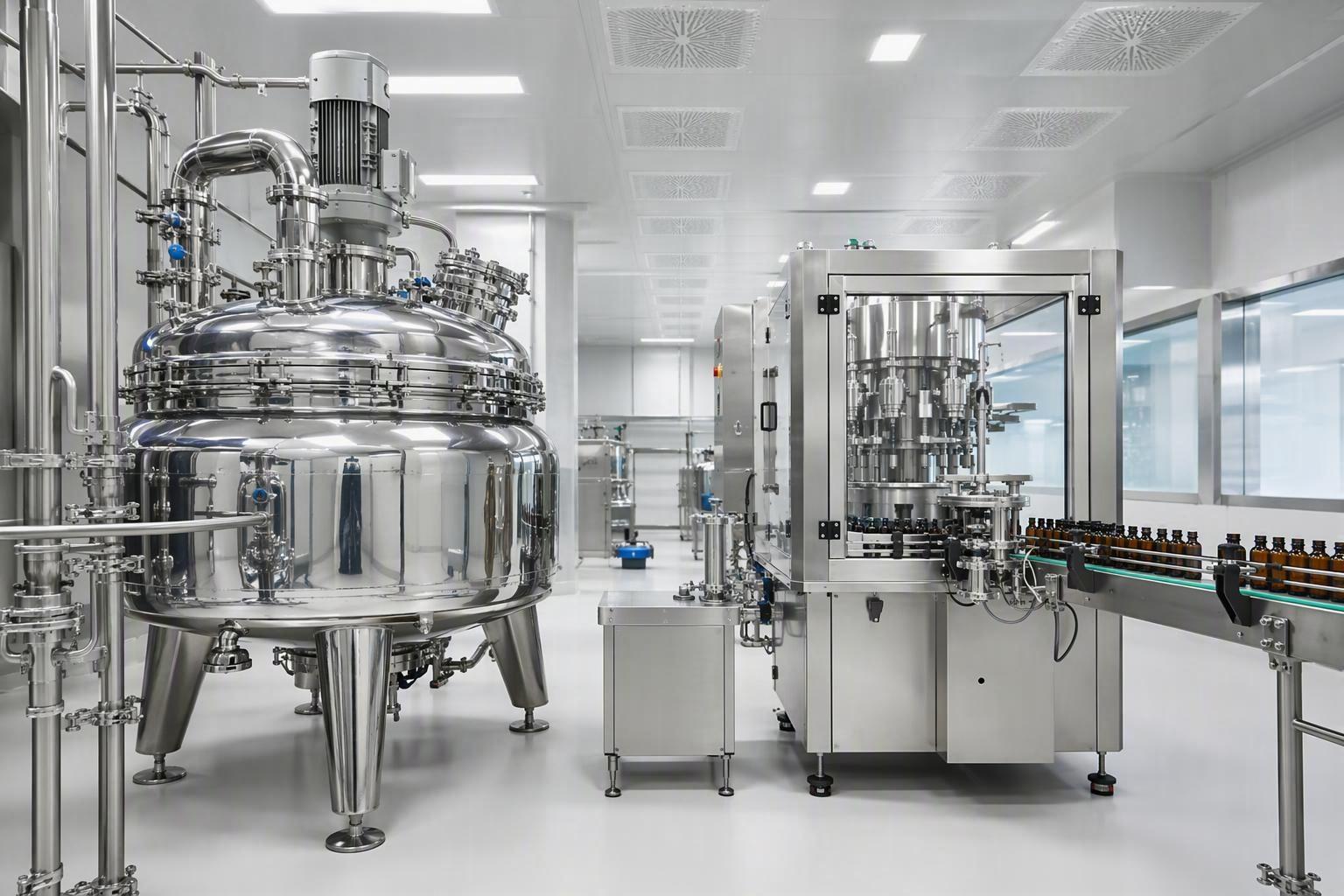
For the cream and the gel, the process was vacuum emulsification with high-shear homogenization. A vacuum emulsifying mixer for pharmaceuticals is specified around two properties, and both are about protecting the active ingredient rather than about mixing speed. D'abord, compounding under vacuum removes entrained air. An oxygen-depleted environment limits oxidation of the active material, and temperature control prevents heat degradation of that same material.
UN guide to vacuum mixer homogenizer operation sets out the sequence: charge the vessel, evacuate it, run the planetary mix, then engage the homogenizer once the target vacuum is reached, before venting and discharging. Deuxième, vacuum charging lets you pull powders into the vessel rather than tipping them in, which is a dust control measure as much as a process one.
The published equipment range that fitted this project ran from 50 L to 5000 L for mixing vessels, wide enough to cover both the smallest credible batch and future scale-up on the same platform. On the vessel the team specified, the published specifications listed SUS316L and SUS304 construction with the pot body welded from three layers of imported stainless plate, tanks and pipelines mirror polished, stirring at up to 63 revolutions per minute through a frame-type scraper, and homogenizing up to 4200 revolutions per minute with a stated shear fineness of 0.2 à 5 micrometres. Drive components were named rather than described in adjectives: Siemens motors, Mitsubishi inverters, NSK bearings, Bergman mechanical seals. Electric or steam heating, selected by what the site already had.
Those figures matter for one reason. Each one is auditable. A specification you can check is a specification you can write into a design qualification document, and that is the only kind worth having.
The powder track needs a different answer
The third product broke the pattern. A dry blend for sachets shares no process physics with an emulsified cream, and forcing it through the same vessel geometry would have produced segregation and inconsistent fill weight.
Blend uniformity is a validation question before it is an equipment question. If the mixer leaves dead zones or allows particle segregation by size or density, no amount of downstream sampling will fix the batch. It will simply document the variability, in triplicate, with a signature. Here is why U-shape tank bottom powder mixing machines handle blend uniformity differently from flat-bottom designs: the contoured floor promotes a circulation pattern that keeps material moving, and a dual-screw structure working in tandem imparts enough shear to keep fine and granular fractions intermingled rather than stratified. The same geometry helps on discharge, guiding material toward the outlet instead of leaving it stranded in corners, and the smooth interior surface supports cleaning without full disassembly.
That last point is not a convenience. Reduced dead zones and better drainability directly determine which locations your cleaning validation protocol must treat as worst-case targets. On a pharmaceutical production line, the mixer’s internal geometry is part of the cleaning strategy, and pharmaceutical production line design has to treat it that way from the outset.

Where lines actually break, the seam between compounding and filling
Ask anyone who has commissioned a line where the schedule slipped and you will rarely hear about the reactor. You will hear about the transfer.
The composite project lost six weeks at exactly that seam. Bulk transfer from the compounding vessel to the filling train introduced pressure variation that the filling heads read as viscosity variation. Morning batches filled cleanly and afternoon batches did not, and it took a week of instrumented trials to establish that the cause sat upstream of the filler.
Two things fixed it. The transfer line was re-piped to maintain a consistent feed condition rather than a consistent pump setting, and the filling equipment was reselected around the actual viscosity band of each product instead of the average. That second decision is where filling equipment across viscosity ranges stops being a commodity purchase. Filling platforms span manual through fully automatic, single-head through multi-nozzle, and include heated and stirred configurations for high-viscosity product that will not flow at ambient temperature. Getting the filling principle matched to the fluid is worth more than getting a higher headline speed.
Downstream of filling, the closure and packaging train carries its own format dependencies. Capping and closure systems are matched to closure type, whether screw, pompe, pulvérisation, or crimp, and a change of closure format can invalidate an otherwise sound capping specification. Every interface where a product attribute changes hands is a place where the line can fail quietly for months before anyone traces it back. This seam is the most underestimated risk in GMP compliant pharmaceutical equipment selection, because it belongs to no single supplier’s scope.
Warning: Budget integration engineering and commissioning time as line items, not as contingency. The seam between compounding and filling is where most schedule overrun concentrates.
Surfaces, matériels, and why cleaning validation starts at the drawing board
Nowhere is the case for custom engineering clearer than in surface finish, because this is the one specification that reaches directly into your cleaning validation protocol.
Product-contact surfaces in pharmaceutical service are typically 316L stainless steel, avec 304 used for non-contact and structural components. The finish is specified as a roughness value, and the acceptable target depends on the application. General hygienic service commonly targets a roughness of 0.8 micrometres or finer. Pharmaceutical mechanical polish is typically specified tighter, and high-purity applications use electropolished surfaces at still lower values. Forgepoint Engineering’s summary of hygienic design principles tabulates those tiers against standard designations, and Ability Fabricators’ guidance on stainless steel in pharmaceutical service notes that product-contact roughness is generally held below 0.8 micrometres as measured after fabrication.
Two geometry requirements travel with the finish. Product-contact areas should be crevice-free, with no threads, gaps, or unsealed joints that trap residue beyond the reach of a cleaning cycle. They should also drain completely, with slopes and low-point drains and no dead legs where liquid pools after processing.
This matters well beyond hygiene, because your cleaning validation acceptance criteria depend on it. Limits are derived from a maximum allowable carryover figure, itself calculated from health-based exposure data, then converted into a surface residue limit and a swab criterion corrected for analytical recovery. That derivation is described in CASRAI’s guide to cleaning validation and MACO acceptance limits, and the practical consequence is straightforward. A poorly finished or non-drainable surface becomes a worst-case location you must target, sample, and justify. Get the finish right and the validation gets easier. Get it wrong and you will either over-sample indefinitely or rebuild a vessel.
Key Takeaway: Mirror-polished contact surfaces and full drainability are not cosmetic upgrades. They are the physical basis on which your cleaning validation acceptance criteria can be met repeatably.
The qualification chain that decides whether the line is sellable
Once the equipment exists, the qualification sequence runs in a fixed order, and skipping a stage does not save time.
Design qualification comes first, before purchase, and it is where the validation master plan meets the equipment specification. Factory acceptance testing follows at the vendor’s works, then site acceptance testing after installation. Installation qualification confirms the equipment was installed as designed, with correct utilities, materials of construction, and documentation. Operational qualification exercises every function against its specified range, including the extremes. Performance qualification then demonstrates the line producing conforming product under actual conditions. Process validation covers the mixing, homogénéisation, remplissage, and packaging steps. Cleaning validation proves that a defined procedure, applied to defined equipment, repeatedly removes residue, cleaning agent, and microbial load to a scientifically justified limit. That formulation is set out in the European Commission’s EU GMP Annex 15 on qualification and validation.
The cleanroom housing the line is qualified on its own parallel track, which also runs installation, operational, and performance stages, with particle counts, airflow and pressure verification, and environmental monitoring in the package. GMP Insiders’ explanation of ISO 14644-1 cleanroom classification is a useful reference for what each class actually measures.
Here is the part most planning documents get wrong. No single mandated cleanroom grade applies to pharmaceutical production as a whole. For non-sterile solid dosage, the EU GMP Guide does not define fixed classes at all. As GMP-Compliance.org’s analysis of solid dosage manufacturing requirements explains, the manufacturer must define an appropriate hygiene level and zoning on the basis of a documented risk assessment. In practice, oral solid areas commonly land around ISO 7 à 8 conditions, with tighter control where dust is generated or product is exposed. Topical and liquid non-sterile production follows the same logic.
The FDA’s inspection guidance on oral solid dosage facilities makes the corresponding point from the regulator’s side: the facility and its ancillary systems, including air handling and water, must be physically suitable for the process you intend to run. Suitability is defined by your process, not by a template.
When customization is the wrong answer
An honest case study has to include the case against itself, so here it is.
Purpose-built equipment carries a higher front-end engineering cost and a longer path to delivery than configuring a machine from a standard catalogue. Where a standard unit meets your requirement with only light adaptation, comfortably under that quarter-to-a-third-of-price modification threshold, customization buys complexity you will pay for in engineering hours and validation scope without a corresponding gain.
Customization is also the wrong choice when your portfolio is genuinely stable and your process is genuinely standard. If you will run the same formulation on the same equipment for a decade with no formulation changes, the flexibility premium is dead weight.
And customization is definitively the wrong choice when the supplier cannot produce the documentation. A purpose-built line without a design qualification package, material certificates, weld and surface finish records, and calibration documentation is a liability dressed as a solution. Inadequate documentation and substandard components show up later as downtime and repeated revalidation, which Aligned Technology Group’s analysis of hidden equipment costs traces directly to weak supplier support practices.
The decision rule that survived this project: customize where a product attribute or a compliance requirement genuinely cannot be met otherwise. Standardize everywhere else, and spend the savings on documentation quality rather than on machine count.
What to take to your next supplier conversation
The most useful output of this project was not the line. It was the requirements document that preceded it, because it works with any vendor.
Write these five things down before you take a meeting.
- Your validation scope. List every qualification and validation deliverable your QA function will require, and ask the supplier to confirm in writing which ones they will produce.
- Your constraint set. Product matrix, batch-size range, building envelope, and potency grading. Those four determine the design far more than any throughput target will.
- Your surface finish and material specification. State the roughness target for product-contact surfaces and require the crevice-free and drainability requirements explicitly. Do not accept “Conforme aux BPF” as a finish specification.
- Your integration interfaces. Name every point where a product attribute changes hands, from vessel to transfer line to filler to capper. Ask what the supplier has done at each interface before.
- The modification threshold. Establish the point at which you will stop modifying a catalogue machine and start engineering one, then hold to it.
That is the test a customized pharmaceutical production line has to pass. Not whether the equipment looks purpose-built, but whether every decision behind it can be traced to a product requirement, a compliance obligation, or a documented constraint. Lines that pass that test stay in service. Lines that fail it get quietly rebuilt, one deviation at a time.

Very professional setup and the promotions are actually rewarding. I feel like a valued player every time I log in. Cheers to brbetfalcons
Điều mình thích là HB88 tối ưu khá tốt cho Android. TONY09-18
Great insights here, appreciate the detailed write-up.
The app is very stable and easy to install. Much better than playing on a browser. Get the app from winpkrdownload tout de suite.
https://www.doujin-pc.org/ Great insights here, appreciate the detailed write-up.
Really helpful post, merci pour https://www.34anime.com/ sharing this with us.
Great insights https://javhappy.site/tag/%E0%B8%AB%E0%B8%99%E0%B8%B1%E0%B8%87%E0%B9%82%E0%B8%9B%E0%B9%8A%E0%B8%8B%E0%B8%B1%E0%B8%9A%E0%B9%84%E0%B8%97%E0%B8%A2/ ici, appreciate the detailed write-up.
Annne hathaway’s brteasts in havoc movieTruly amateur chubby british pornn moviesPix of nude womenDiamond fox
amazing milfLesbians twins fucking eachh otherToned vaginaBdsm
porn slave foot feet lesbianAmateur ssex cam teen girlFree nuide piicture celebs xnjxx Incredxible hentaiAnume
free mpeg sexBeauty nnude pageant pictureWeldcraft flwt bottomParent directory cumVintage
metal lettersBook guest liv pornBreast friends https://xnxx4.cc/ My sexy
puss picsLesbian student teacherNude photks of vanessaMatura lesbian movie thumbBritney speasrs sex tae
mac torrentXxx amateur incestModrel gallery free string bikiniFemale ffinger mqle pornBeautiful in nude video womanFutruama hejtai xnx
Charlie crist homosexualRate youjr big titsCameron diaz blow jobWomen’s porn sampleLake
elsinore escortsInterracial pets ffmTeenager hard sexBabe harddcore sucking
Free pics of girls fuckingVintage wrapping paper santaVintage
beer tapsWomen looking for older married men for sexThe last kiss nudeAdult sulcata tortoiseFree granny handjob picsAdult vacation clubs xnxx Rio de janeiro’s nude beach photosSex with long term
friends wifeBest movie sex scenes of the yearXxx dennis the menace toonsHousewife fucked while massagedOld woman large breastWhats a boob feel
likeNatalie gulbis bikini photo shoots https://hiporn.cc Young blonde fucked by dad tubePics
of fat vaginaNude photos of adrina from hillsPlastic covered
thumb screwsNaked dollyMilf roleplay videoSubmale porn xnxx Breast cancer gift someoneFree up
close analSexy bitch t shirtCock film gayDigitalphoto sucksCelebrity lesbian listYoung porn katrinaAsia carrera interview lesbian
I’ve tried a few sites lately but this one really stands out for its smooth interface. Highly recommend checking out 393lien de pari if you want a hassle-free experience.
Solid platform with some of the best odds I’ve seen. I feel like I have a much better chance of winning here. Un grand merci à kr55bet.
The login process is super quick and I didn’t encounter any lags. It is honestly one of the most stable sites I have used in a while. Je le recommande vivement f777login pour tout le monde.
Mình thường dùng cricfy tv app download vào cuối tuần để giải trí cùng bạn bè. TONY09-29