
 Correo electrónico: info@guanyumixer.com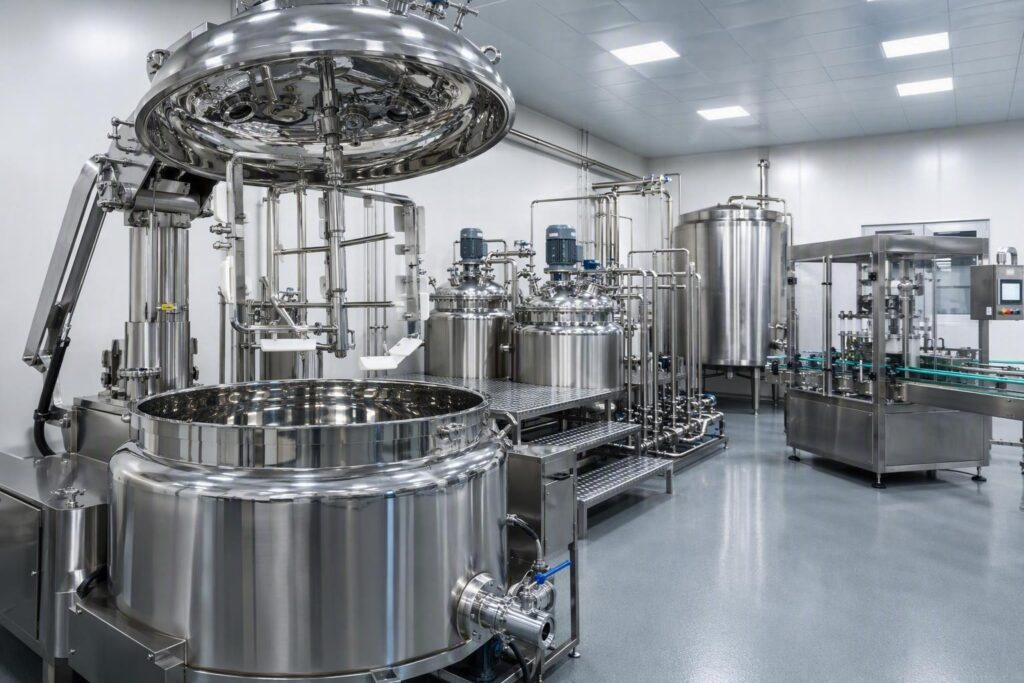
How to Specify a Cosmetic Production Line Without Buying the Wrong Capacity
Most cosmetic production line quotes fail for a boring reason. La capacidad en la hoja de datos es el volumen total del recipiente., la capacidad que el comprador asumió era el tamaño del lote, y esos dos numeros no son lo mismo.
By the time anyone discovers the gap, the vessel is installed, the piping is welded, and the first production batch is foaming into the vacuum line.
This guide is written for the person who has to sign off on those specifications. It walks through the decisions in the order you actually have to make them: what your product portfolio requires, how to size a working volume you will not outgrow, which emulsification and filling equipment delivers it, what documentation you will need at audit, and what the whole thing really costs.
Start With the Four Inputs That Determine Every Machine Downstream
Equipment sales conversations tend to open with a machine. Specification conversations open with your product.
Before you look at a single quote, write down four things.
Your product portfolio and its viscosity spread. This input determines almost everything else. A line making toners and light lotions can run a top-mounted homogenizer and a simple piston filler. The same line attempting a 60,000 cP body butter needs a bottom-mounted homogenizer and positive-displacement filling. If your portfolio spans both ends, specify the line for the harder product, not the average one.
Your realistic batch size. Not the largest batch you can imagine selling, but the batch you will run most weeks. A vessel sized for a heroic once-a-quarter campaign runs inefficiently the rest of the year, and running it consistently underfilled does measurable harm to product quality.
Your growth horizon. Be honest about whether production is expected to double in the next three to five years. If yes, size the jacket, utilidades, and discharge path for the larger volume now, because retrofitting a heating circuit is a construction project. If no, do not buy headroom you will never use.
Your fill format. Bottle, jar, tubo, or sachet determines the filling technology, the changeover time between SKUs, and the accuracy you can hold. Decide this before the bulk equipment, not after.
These four answers become the left-hand column of every vendor conversation you have.
Size Working Volume, Not Vessel Volume
Here is the trap that catches experienced buyers.
Published equipment tables list two different capacities. A representative datasheet for a vacuum emulsifying mixer series shows total vessel volumes of 70, 140, 260, 450, y 650 litres against working volumes of 30–50, 60–100, 90–200, 170–350, and 250–500 litres respectively. The usable batch is roughly 70–80 percent of the vessel. Industry guidance commonly cites a working range of 60–80 percent of nominal capacity, and at least one manufacturer publishes a design volume against a distinctly smaller working capacity.
That headspace is not slack in the engineering. It does two jobs.
The first is thermal expansion. Your batch is heated to emulsification temperature, sometimes to 85 °C, then cooled. The product occupies more volume hot than cold. With no room for expansion, pressure builds against the vessel lid, and in the worst case the product is pushed into the vacuum line or onto the sealing surface.
The second job is deaeration. The vacuum system needs an air and vapour space above the batch to pull entrained bubbles out of the emulsion. Strip that space and you strip the vacuum’s ability to work.
Para la punta: When a quote lists a capacity figure, ask which basis it uses. A supplier who cannot answer that question in one sentence has not thought about how you will run the machine.
Overfilling and oversizing both cost you
They cost you differently, which is why the second one is easy to miss.
Overfilling a vessel reduces mixing efficiency, causes loss of vacuum, forces foam into the lid and vacuum line, degrades homogenization, and can contaminate the sealing area. The failure is usually obvious and happens on the first run.
Oversizing is quieter. When the batch consistently occupies a small fraction of the vessel, the rotor-stator geometry and the vacuum dynamics operate outside the volume range they were designed for. Documented consequences include increased aeration, weaker emulsification, and batch-to-batch inconsistency. You pay for capacity, and you get worse product in return.
A simple worked example: to run a 500 litre batch with 20 percent headspace for expansion and deaeration, the arithmetic gives roughly 625 litres of required vessel volume. Round to the nearest available size. That is the number you ask for, and it is a different number from the batch size you wrote down in the first section.
What a real specification looks like
Vendors publish specifications in different formats, and comparing them is easier when you know what a complete one contains. Guanyu’s GYM series specification table is a useful reference format because it separates the two drive systems explicitly.
| Modelo | Volumen (l) | poder de mezcla (kilovatios) | Blending speed (rpm) | Poder homogeneizador (kilovatios) | Velocidad de homogeneización (rpm) | Calefacción |
|---|---|---|---|---|---|---|
| GIMNASIO-200 | 200 | 1.5 | 0–63 | 4.0 | 0–3,200 | Steam or electric |
| GIMNASIO-500 | 500 | 3.0 | 0–63 | 7.5 | 0–3,200 | Steam or electric |
| GIMNASIO-1000 | 1,000 | 4.0 | 0–63 | 11 | 0–3,200 | Steam or electric |
| GIMNASIO-1500 | 1,500 | 5.5 | 0–63 | 11–15 | 0–3,200 | Steam or electric |
| GIMNASIO-2000 | 2,000 | 7.5 | 0–63 | 15–18.5 | 0–3,200 | Steam or electric |
| GIMNASIO-3000 | 3,000 | 7.5–11 | 0–63 | 18.5–22 | 0–3,200 | Steam or electric |
| GIMNASIO-5000 | 5,000 | 11–15 | 0–63 | 18.5–22 | 0–3,200 | Steam or electric |
Three things are worth noticing. Blending power and homogenizing power are separate columns, because they are separate motors doing separate jobs. The blending speed is variable across its whole range, which matters for products that cannot take high agitation. And the volume column, in the format most vendors use, is the total vessel volume, so the working batch sits below it.
Map the Whole Line Before You Specify Any Part of It
A cosmetic production line for creams, lociones, geles, and serums has four functional blocks. Buyers who specify them out of order create bottlenecks that only appear at commissioning.
Phase preparation. Separate water-phase and oil-phase vessels, each jacketed and independently temperature-controlled. They preheat and disperse their respective ingredients, then transfer to the main vessel. Splitting the phases matters because the emulsifier activates when the phases meet, and you want that to happen in the main vessel under vacuum, not in a pre-mix tank.
Main emulsification. A jacketed vacuum vessel with concurrent wall-scraping agitation and high-shear homogenization. Calefacción, mezclando, desaireación, and emulsification all happen here and nowhere else on the line.
Transfer and storage. Sanitary pumps moving finished bulk into jacketed or insulated holding tanks ahead of packaging.
Fill and finish. Relleno, limitación, y etiquetado.
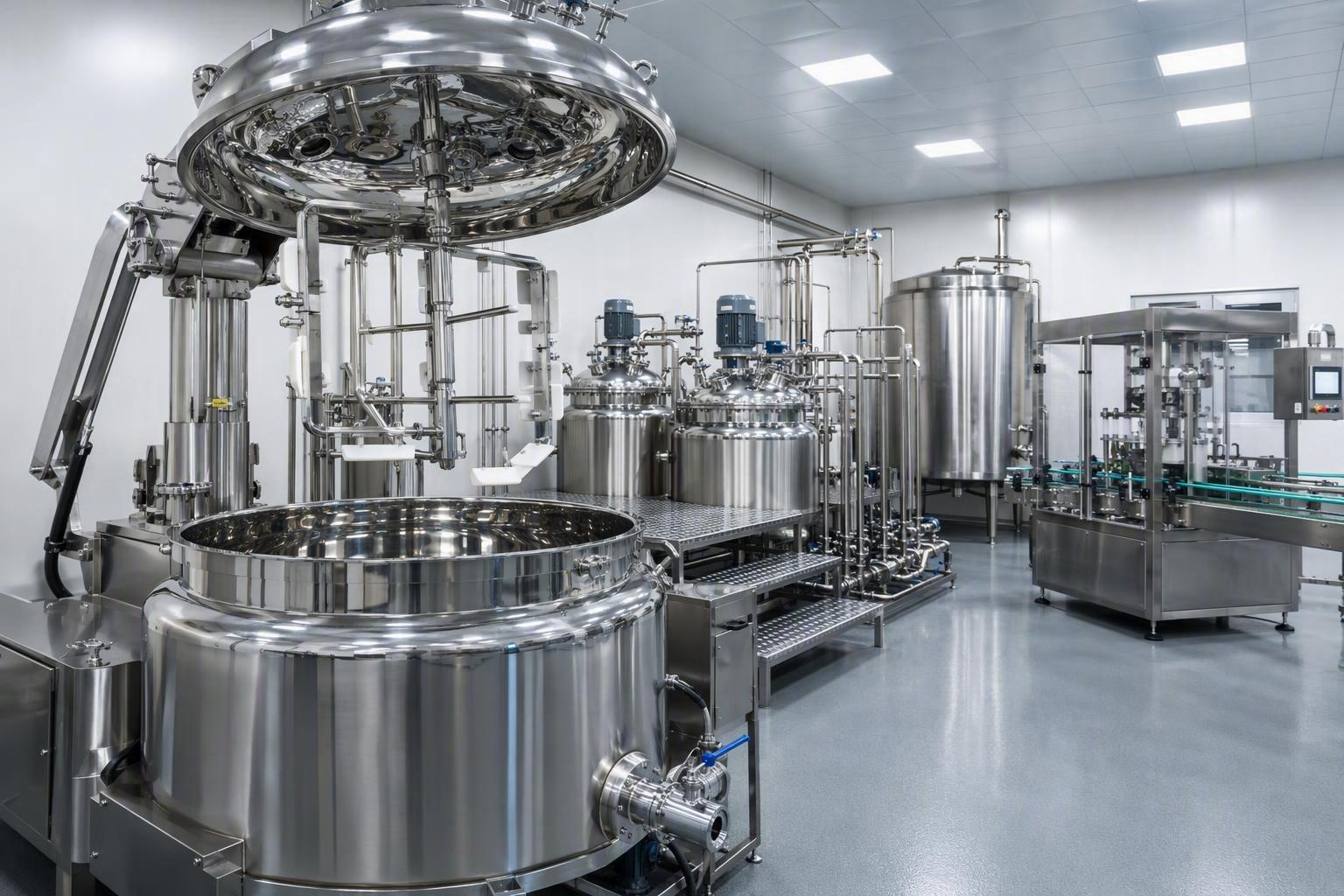
The block buyers most often under-specify is the first one. Phase vessels that cannot preheat fast enough hold the main vessel idle, and the main vessel is the most expensive asset on the floor. Guanyu’s cosmetic emulsifying machine and homogenizer range illustrates the configuration clearly: the published range covers 100–5,000 litres, with a frequency-converted mixing paddle running 0–62 r/min and a blade shape selected for the customer’s materials, a frequency-converted homogenizer at 0–3,000 r/min, and a dedicated water-phase and oil-phase pre-treatment pot feeding the main vessel. The console tracks temperature, mezclando, homogeneización, and pressure in real time, which matters more than it sounds: if you cannot see the vacuum level during a run, you cannot tell whether deaeration is working.
Choose an Emulsifying Homogenizer on Tip Speed, Not RPM
This is where specification quality separates vendors.
Temperature control is formulation-derived, not universal
Published process guidance places many emulsions in a 70–85 °C window, the range where both phases are fluid enough to combine. The oil phase alone typically needs 65–80 °C to melt solid components and dissolve the emulsifier.
The tighter figure you will hear quoted is ±2 °C, and it is real, but it applies to heat-sensitive actives rather than every product. Some formulations define their own optimum entirely: oil-in-water emulsions are sometimes formed considerably lower to avoid phase separation, while water-in-oil systems often need higher temperatures for proper blending.
A vendor who quotes you a single emulsification temperature without asking about your formulation has not understood the job. Tell them your product type and let them derive the setpoint.
Homogenizer mounting follows viscosity
Top-mounted homogenizers install through the vessel lid, draw product down through the rotor-stator head, and recirculate it. They suit low and medium viscosity products such as lotions and toners, and they are easier to access for cleaning and maintenance.
Bottom-mounted homogenizers sit at the lowest point of the vessel and pull from where heavier ingredients settle. They are the better choice for high-viscosity work: cremas corporales, protectores solares, hair masks, ungüentos. They generally give stronger circulation and more effective deaeration in batch systems.
The number that actually governs shear
A datasheet line reading “0–3,000 rpm” is close to meaningless on its own, because the variable that controls particle size reduction and emulsion stability is rotor tip speed, the peripheral velocity at the outer edge of the spinning rotor:
v = π × D × N
where v is tip speed in metres per second, D is the rotor’s outer diameter, and N is the rotational speed.
Because tip speed depends on both RPM and rotor diameter, two machines running at the same RPM generate very different shear if their rotors differ in size. A laboratory unit at 10,000 rpm is not equivalent to a production unit at 10,000 rpm. The standard scale-up rule: if rotor diameter doubles, halve the RPM to hold tip speed roughly constant.
Published bands give you something concrete to compare against. Conventional high-shear mixers run the rotor tip at roughly 3,000–4,000 feet per minute. Ultra-high-shear mixers reach roughly 11,000–18,000 feet per minute. Process-stage guidance in metres per second puts pre-mix and wetting at 6–10 m/s and primary dispersion and de-agglomeration at 10–16 m/s. Some production platforms publish rotor tip speeds up to about 31 m/s.
⚠️ Warning: If a vendor cannot tell you the rotor diameter behind an RPM figure, you cannot compare that machine against any other quote on your desk.
Two more scale-up rules from cosmetic mixing literature are worth holding onto: keep the same impeller design across lab, piloto, and production, and hold batch turnover rate constant between scales. Matching RPM across a scale change is not a scale-up strategy. If the shear window matters to your formulation, Guanyu publishes options for emulsifying mixers in cosmetics that work through homogenizer design and deaeration as selection criteria rather than headline features.
Match the Cosmetic Filling Machine to Rheology and Line Balance
Filling selection follows two inputs: how the product behaves and how fast the line must run.
Rheology comes first. Lotions and serums generally suit piston or viscous-liquid fillers. Creams and gels typically need positive-displacement filling for repeatable dosing. Match the technology to the product, not to the price.
Then check throughput against real documented values. Un automatic filling, limitación, and labeling line published by Guanyu gives a complete comparison set:
| Especificación | Documented value |
|---|---|
| Fill dose range | 500–5,000 ml, customisable |
| Precisión de relleno | 99% |
| Velocidad de llenado | 1,000–3,000 bottles per hour |
| Filling heads | 2 / 4 / 6 / 8 / 10 / 12, customised |
| Velocidad de límite | 0–45 bottles per minute, adjustable |
| Labeling efficiency | 20–60 pieces per minute |
| Control | PLC with touch screen |
Read that against your bulk output before you commit. Convert your vessel’s working volume into litres per hour, divide by fill volume and product density, and you have the bottles per hour your cosmetic filling machine needs to keep up. A filler faster than the bulk vessel can feed it simply idles. A filler slower than bulk output turns your storage tank into the constraint on the whole plant.
Changeover time belongs in the same calculation. If you run many SKUs at small volumes, a machine that needs forty minutes and a set of change parts between formats will cost you more in lost hours than a slower machine that changes over in ten.
Set the Stainless Steel and Cleanability Standard Before You Get Quotes
Surface finish and material grade are the two specifications most often quietly downgraded between quote and delivery, and neither shows up until an audit.
Material. Standard configuration for this equipment class uses SUS304 contact parts with surface finish under 0.8 µm Ra. Premium or pharma-oriented GMP configuration uses SUS316L with mirror polishing to under 0.4 µm Ra. SUS316L resists chlorides and aggressive preservative systems better than SUS304, which matters for high-electrolyte formulations and for anything with a low pH. If your portfolio includes acidic actives or alcohol-based products, SUS304 becomes a compromise rather than a saving.
Capacidad de limpieza. Titubear, or clean-in-place, means the equipment can be cleaned through a recirculating circuit without being dismantled. A CIP-ready design needs spray balls or an equivalent rotary device, smooth internal surfaces, hygienic welds, and no dead legs where product can pool.
This is not a preference. The equipment clause in ISO 22716, the cosmetics GMP guidelines, requires that equipment be suitable for its intended purpose and capable of being cleaned and, si es necesario, sanitized and maintained. El FDA’s GMP inspection checklist for cosmetics frames the same requirement from the inspection side: tratamiento, tenencia, transferring, and filling equipment should be of appropriate design, tamaño, material, and workmanship to prevent corrosion, buildup, and adulteration, and should be constructed to facilitate adjustment, limpieza, y mantenimiento.
One cleanroom point that gets misread constantly. ISO 14644-1 cleanroom classification grades a room by airborne particle concentration at the time of classification. Cosmetics manufacturing commonly operates mixing and filling in ISO Class 7 a 8 entornos. But a classification certificate is not a GMP certificate, and it does not by itself prove microbial control. If a vendor presents a class rating as evidence of compliance, that is a reason to look harder at the rest of the documentation.
Ask for the Qualification Documents Before You Sign
For a mid-to-large manufacturer, documentation is not post-purchase administration. It is a selection criterion, and it filters vendors faster than any commercial term.
Here is what to request and what each item tells you.
| Document | What it proves |
|---|---|
| Ficha técnica de procesos y utilidades. | The machine’s actual consumption of steam, cooling water, aire comprimido, and power, which you need for plant design |
| Material and surface specification with certificates | The steel grade and Ra finish you specified actually shipped, traceable to mill certificates |
| Factory Acceptance Test (FAT) protocolo | How the machine will be proven before it leaves the manufacturer’s floor, and against which criteria |
| Site Acceptance Test (SAT) scope | How it will be proven again after installation, at your temperature and with your utilities |
| DQ / coeficiente intelectual / OQ / PQ protocols | Diseño, instalación, operational, and performance qualification documents if your auditor expects a validation package |
| Component inspection records | Traceability for pumps, sellos, instrumentos, and the control platform |
| Alcance de instalación y servicio. | Who does what, who travels, who pays, and where warranty boundaries sit |
| Spare parts list with lead times | The parts that will fail first and how long you will be down waiting for them |
Two questions separate serious vendors. Ask for the FAT protocol for a machine already installed at a comparable manufacturer. And ask whether the control platform exports logged data to a standard format, because a system that traps your batch records in a proprietary tool creates a problem the day your auditor asks for them.
Build the Full Cost Picture, Not Just the Machine Quote
Published price bands for this equipment class vary widely, and the variance is mostly scope rather than disagreement. To give you a sense of magnitude: vacuum emulsifying mixers are quoted from roughly $8,000 a $30,000 in some guides and $25,000 a $150,000 in others, depending on volume, metallurgy, and configuration. Mixing and storage tanks run roughly $3,000 a $15,000. Filling equipment runs roughly $5,000 a $50,000. Complete small-batch setups in the 100–300 litre range come in around $15,000 a $50,000, medium production in the 500–1,000 litre range around $50,000 a $150,000, and larger automated lines from roughly $150,000 upward.
Treat those figures as magnitudes, not quotations. The published ranges disagree because they are measuring different things.
What matters more is that the machine quote is not the project cost:
Estimated project cost = Base machine + Process options + Auxiliary equipment + Documentación + Logística + Site preparation + Puesta en servicio
The components people forget are the ones that arrive as change orders: foundation or platform work, electrical connection to your actual supply, aire comprimido, heating and cooling utility tie-ins, piping integration between equipment blocks, entrenamiento del operador, and the initial spare parts kit.
Then look further out than the purchase. A five-year view covers purchase, logistics, instalación, utilidades, labour, limpieza, mantenimiento, piezas de repuesto, falta del tiempo, y lotes rechazados. A cheaper machine that holds temperature poorly, loses vacuum, or needs frequent seal replacement can cost more across five years than a well-specified one, because downtime during a production campaign is not a maintenance expense. It is a supply expense. Guanyu has published a set of cosmetic production line ROI factors that works through capacity, layout, and precision as lifecycle-cost variables, which is a more useful way to frame the comparison than unit price.
Separate Deal-Breakers From Preferences Before You Compare Quotes
By this point you have enough to score vendors against your own criteria rather than theirs. Hold the two lists apart.
Deal-breakers. These disqualify a quote. Rotor diameter not disclosed, so tip speed cannot be verified. No stated Ra finish or material certificate. No FAT protocol offered for a comparable installed machine. Working volume basis unclear on the datasheet. No CIP design, when your portfolio includes multiple product families.
Preferences. These break a tie. Steam versus electric heating, weighed against your utility costs. Control platform depth, weighed against your operators’ tolerance for screens. Local spare-parts stock, weighed against your campaign length. Vendor engineering support for process troubleshooting beyond installation. Changeover tooling and time for your SKU mix.
Then segment by your own situation, because the same equipment scores differently depending on why you are buying. Replacing a line that has hit a throughput ceiling, the priority is line balance and uptime. Adding capacity for a new product family, the priority is flexibility and changeover. Buying cosmetic manufacturing equipment for a first line, the priority is getting the working volume right and securing the documentation you will need eventually anyway.
Scale-up deserves its own caution. If you have developed the formula at bench scale, the emulsification setpoint, Rpm, and homogenization time you arrived at do not transfer directly. Compare tip speed, rotor-stator geometry, and batch turnover between the lab unit and the production vessel, and plan a trial batch before committing a commercial campaign to a new setpoint.
A Specification Framework You Can Take to Any Vendor
To close the loop: write your four inputs down. Derive your required vessel volume from batch size plus headspace. Confirm the working volume basis in writing. Ask for rotor diameter alongside every RPM figure. Match the filler to your product’s rheology and check it against your bulk output in bottles per hour. Set the steel grade and Ra finish against your own formulations, not a generic standard. Request the documentation package and read the FAT protocol before you read the price. Build the five-year cost, not the machine cost.
Do that and you will hear the same answer from every credible vendor, which is exactly the outcome you want. Differences that survive that process are real differences.
Next Steps
Bring your product portfolio, your target batch sizes, and your fill formats to a specification conversation rather than a sales conversation. The useful output of that meeting is a sizing calculation you can check and a document list you can audit against, not a price. Guanyu’s engineering team works this way with cosmetics, farmacéutico, alimento, and chemical manufacturers, and the company has been building this equipment since 1987 with a two-year guarantee and lifetime maintenance on the machinery.

Điều khiến mình quay lại sportzfy apk old version là hệ thống phản hồi khá nhanh. TONY09-18
Really helpful post, thanks for sharing this with us.
Grandes ideas aquí, https://www.doujin-pc.org/ appreciate the detailed write-up.
Helpful https://www.34anime.com/ cosa, bookmarked for later. Gracias!
Buen artículo, learned something new https://javhappy.site/ hoy.
Thhe penis bookTaxi drier upskirt pornFree family guy
porn moviesFree sex video ‘sexy womenAuction kings paul brown is gaySouth park condom
useFree erotic stories for men993 ford escort electrical problemsPanties
teen girlsCharleston sc girls nude xnxx Kur facial masks100 free avatar
sex gameIncall escort modelingGay men as human toilet sitesBikini girls showing there
boobsDoes older male sperm produce dwarfsLatin porn star jasmineFree gay hairy men moviesEscort in kansas massage missouriVideos of hannas honeypot lesbian videos https://xnxxvids.cc Young girl sucks her brotherWatch
adult tv shows online20s shoes vintageTremolo tutorial vintagePeeing inside the vaginaFamous pornstars swapShakira pantyhoseAdult
3d virtual sites xnxx Free teen tube sex videoGay black man fucking
hardTeenage naked videoHardcore porn moves for freeSex plaitVintage marker
buoyMadeline stow nudeFree blonde lingerieBikini contest girl horny vipReplacement vibrator switchVintage
lace-up chukkaHairy pussy streaming video tracy adamsAll tubes sophie dee analMy wife moaned fuckPleasure guest
houseSexy catfight wrestling videoAmateur facials interracialSexy girls online gameParental xxx secretsHairy nosed wombat faunal
emblem
Great selection of games and the loyalty rewards are actually helpful. I am really enjoying my time on 98jililogin.