
 بريد إلكتروني: info@guanyumixer.com
Smart Control Systems for Emulsifying Lines: From Manual Recipes to Repeatable Production
An emulsifying line without smart control depends on the operator’s memory. The same product changes from batch to batch, defects appear when a key person is away, and scaling up means retraining the whole team. This guide explains what a modern PLC control system does for an emulsifying line, which functions deliver real consistency, and what to specify so automation pays for itself.
Why Smart Control Changes Emulsifier Economics
Emulsification is a process of parameters: temperature ramps, homogenizer speed, مستوى الفراغ, agitator speed and mixing time. When those parameters are entered by hand, they drift between operators and between shifts. A smart control system locks the recipe into the machine, so the tenth batch matches the first, and the quality no longer depends on who is running the line.
The economics follow directly. Fewer failed batches, faster changeovers between products, and reduced training cost make the control system an investment with measurable payback, not a convenience feature.
The PLC and HMI Architecture
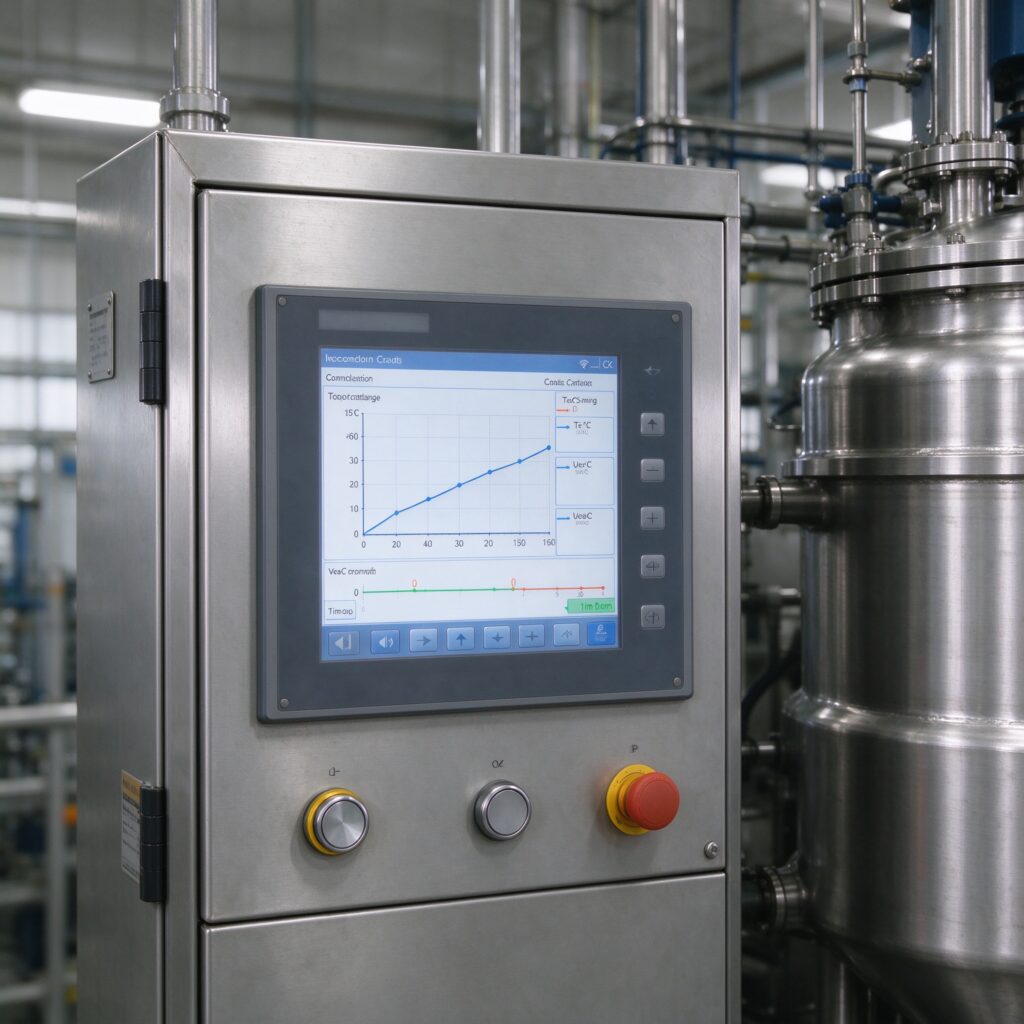
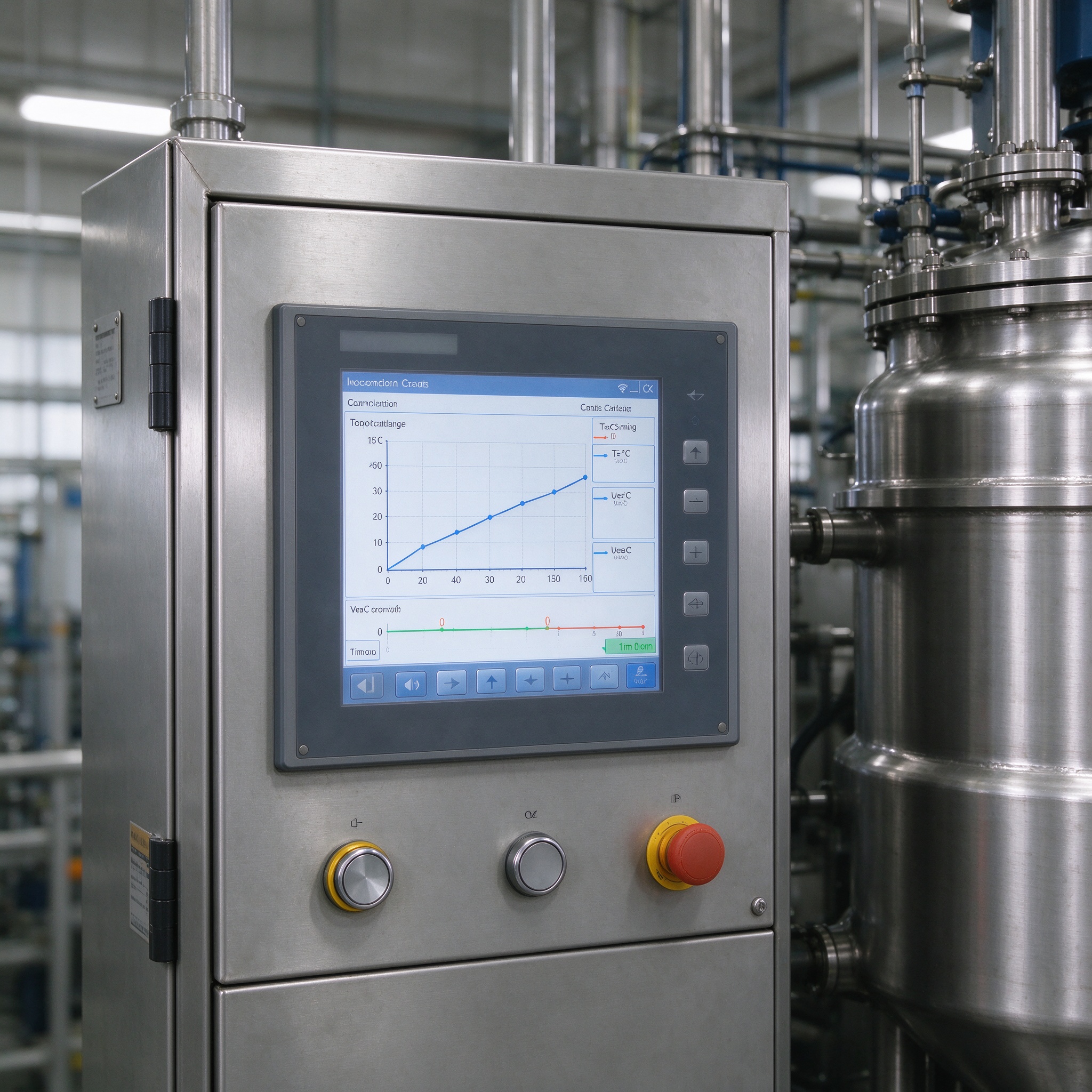
The backbone of a smart emulsifying line is a programmable logic controller paired with a human-machine interface, usually a touchscreen. The PLC executes the process sequence; the touchscreen gives the operator a clear window into temperature, سرعة, vacuum and stage. This architecture is what turns a batch of machinery into a controlled process.
The practical difference appears in the details: a single screen showing the full batch stage, alarms that explain the problem instead of a flashing light, and a process that stops or adjusts according to the recipe when something drifts. This visibility is what lets one operator manage the line confidently and consistently.
Recipe Management: The Core of Repeatability
Recipe storage is the feature that most directly protects product quality. The system stores hundreds of recipes, each with its own temperature curve, homogenizer speed, vacuum profile and mixing time, and recalls them with one selection. The operator selects the product; the machine runs the process.
Recipe management also protects you from tribal knowledge. When the senior operator leaves, the recipes stay in the machine. New operators are trained against a fixed process instead of against a person’s habits, which is how a smart line keeps quality stable during staff changes.
Process Parameter Control: درجة حرارة, سرعة, Vacuum and Time
Each process variable needs real control, not just a display. Temperature control manages the heating and cooling jacket through the phase, homogenizer speed is adjustable to the formula, vacuum pulls the batch to the specified level for deaeration, and the mixer runs at the recipe speed for the required duration.
The sequence matters as much as the values. Emulsification is staged: premix, التجانس, deaeration, cooling and discharge. A smart system sequences these stages automatically and only advances when the previous stage completes, which removes the operator judgment calls that cause inconsistency. The selection criteria for the equipment itself are in our دليل اختيار خلاط الاستحلاب فراغ.
Data Logging and Batch Traceability
A smart line can record every batch: حدود, timestamps, alarms and deviations. That log is worth having when a customer complaint arrives, because it lets you verify what actually happened during the batch instead of relying on memory. Batch traceability is also increasingly required for audits and for brand customers who want process evidence.
The logging requirement affects the specification. Ask for the parameters to be logged, exportable and retained for a defined period. If the control system cannot produce a batch record, the automation is only half-finished.
Alarms, Safety Interlocks and Failure Handling
Automation has to protect the batch and the operator. The control system should alarm on out-of-range temperature, ضغط, vacuum and motor conditions, and interlock the steps so a stage cannot start before its prerequisite completes. A smart system also handles failures gracefully: it holds the batch in a safe state, reports the cause and helps the operator recover instead of losing the product.
Safety is part of the specification too. Emergency stops, guard interlocks and pressure protection should be integrated into the control design, and the supplier should document the safety functions rather than leave them implicit.
Networking and Remote Support
A modern control system can connect to the network, which changes how you support the line. Parameters can be monitored remotely, and the supplier can diagnose issues without waiting for an on-site visit. For a factory in another country, remote support shortens downtime dramatically and reduces the cost of service calls.
Specify the communication protocol and remote access carefully, because it touches both convenience and security. The line should be reachable for support when you want it and locked down from the outside otherwise.
Validation and Documentation: Making Automation Auditable
Automation needs its own documentation trail. The supplier should provide the control logic description, the parameter list, the alarm and safety matrix, and the operating documentation. When your customer or a certification body asks how the process is controlled, the documents are the answer.
For pharmaceutical-adjacent or audited lines, validation may extend further: installation qualification, operational qualification and performance qualification against the process. Confirm with the supplier which qualification level your line requires before purchase.
Supplier Checklist: 8 Points for Smart Emulsifying Lines
When you specify a smart control system for an emulsifying line, verify these eight points. Each one covers a function that fails visibly if it is missing.
- 1. PLC and touchscreen HMI with a full process view of the batch.
- 2. Recipe storage with temperature, سرعة, vacuum and time profiles per product.
- 3. Automatic stage sequencing with completion conditions between steps.
- 4. Data logging with exportable batch records for traceability.
- 5. Alarm and safety interlock system covering temperature, pressure and motors.
- 6. Remote support capability for diagnosis and parameter monitoring.
- 7. Control documentation: logic description, parameter list and alarm matrix.
- 8. Qualification support: معدل الذكاء, OQ and PQ documentation for audited lines.
Working through these eight points before purchase turns automation from a feature list into a process guarantee. For the line-level automation view, see our liquid soap line automation guide and the automatic mayonnaise line efficiency analysis.

التعليمات: Smart Control Systems for Emulsifying Lines
What does a smart control system do for an emulsifying line?
It locks the recipe into the machine, sequences the process stages automatically and logs every batch, so product quality stays consistent regardless of the operator and can be traced afterwards.
Why is recipe management important in emulsifier automation?
Recipes store the full parameter profile for each product and recall it with one selection, eliminating manual entry drift and protecting the process when staff change.
What parameters should the control system manage?
Temperature curve, homogenizer speed, مستوى الفراغ, agitator speed and mixing time, sequenced by process stage from premix through discharge.
Does a smart line support remote diagnosis?
With network connectivity, parameters can be monitored remotely and the supplier can diagnose issues without an on-site visit, which shortens downtime and cuts service costs.
What documentation should come with an automated emulsifying line?
Control logic description, parameter list, alarm and safety matrix, operating documentation and, for audited lines, IQ/OQ/PQ qualification records.
اتصل بنا
Planning a smart control system for your emulsifying line and want the recipe and traceability requirements confirmed? Send us your products and batch sizes, and our engineers will propose the PLC configuration, recipe structure and validation documentation with a factory test video.
Refer to the EHEDG hygiene design guidance for the hygienic engineering principles that control and cleanability documentation should reference.